Geography Geography 5 min read

Thriving in the heat

This is the most dangerous scorpion in all of North America!

Image: Dennis Thompson / PetrCZ

The desert can be one of the most dangerous environments for humans. However, despite the harsh conditions, a surprising number of species not only can survive but also exhibit incredible traits and abilities. If you're ready to meet 10 of these powerful (and, we must admit, threatening) creatures, keep reading!

1
Chuckwalla

Image: Matthew Mentley

The chuckwalla can grow up to 16 inches long, making it one of the largest desert lizards. However, its size isn't the most impressive thing about it. What sets it apart from the rest is its ability to inflate like a balloon to twice its size! That's right; chuckwallas inflate their bodies to fit perfectly into holes and crevices in rocks, making it nearly impossible for predators to pull them out.

As if that weren't enough, these lizards live in desert environments with virtually no water. Although they do take in some liquid, most of their hydration comes from the plants they eat.

2
Kangaroo rat

Image: Michael Jerrard

The incredible kangaroo rat is a specialist in surviving the harshest environments. One of its talents is construction; this rodent knows how to build elaborate burrows in sandy soils for shelter and protection. In addition, kangaroo rats have fur-lined cheek pouches that allow them to carry food from where they find it back to their burrows.

But what makes them unique is their jumping ability. As small rodents (just 3.5 to 5.5 inches), their leap is surprising: they can reach up to 9 feet in a single bound! Plus, like the chuckwalla, the kangaroo rat also survives in the desert on minimal water intake.

3
Gila monster

Image: David Clode

The Gila monster is as famous as it is amazing. This reptile, native to the southwestern United States and northern Mexico, stands out for its unique appearance: a dark, scaly skin with pink or orange spots. In addition, the Gila monster has something that makes it special: it's one of only two venomous lizards in North America. Its potent venom is full of neurotoxins that affect the nervous system of its prey, causing intense pain, swelling, bruising, and even paralysis.

4
Mojave green rattlesnake
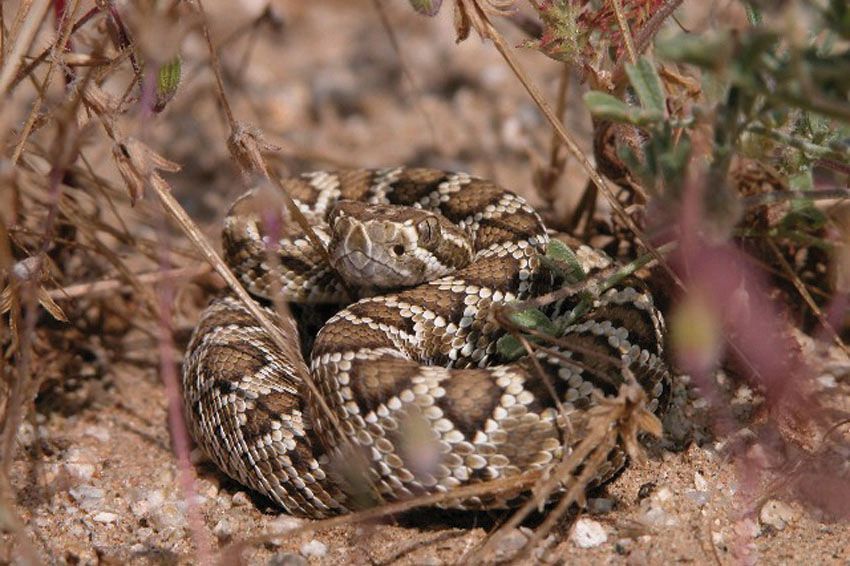
Image: Photo by Mark Bratton, Public domain, via Wikimedia Commons

While any snake can be terrifying to most of us, the Mojave Green Rattlesnake stands out for several reasons.

The crotalus scutulatus —according to its scientific name— is distinguished by its greenish hue, which not only gives it its characteristic nickname but also helps it camouflage in the desert sand. This snake is not only venomous but is considered one of the most dangerous rattlesnakes! Its potent venom contains neurotoxins that, if left untreated with antivenom, can be lethal to various species, including humans.

5
Cactus wren

Image: Carol Lee

You've probably tried transplanting a cactus or got close to one, only to end up with tiny thorns that pricked you for days. But this doesn't happen to the cactus wren, an amazing bird known for its exceptional adaptation to the desert.

As its name implies, one of the most impressive features of the cactus wren is its ability to build large and sturdy nests on cacti without getting hurt. As if that weren't impressive enough, the bird's cleverness leads it to cover its nest with snakeskin to discourage potential predators. Incredible, right?

6
Green tarantula

Image: Thomas Oldenburger

Spiders are among the most feared creatures by humans. But if there's one spider that could scare even the bravest, it's the Mojave green tarantula, which can grow up to 4 inches long and has legs that span up to 6 inches!

Its venom delivers intense pain to its prey while simultaneously paralyzing them. In addition, these tarantulas have urticating hairs that irritate predators' skin, eyes, and respiratory systems. On the other hand, one of their great traits is their lifespan: This species can live up to 25 years in the wild!

7
Sidewinder rattlesnake

Image: Michael Jerrard

The sidewinder rattlesnake is definitely one of the desert bosses. You can tell it’s dangerous just by seeing it: Its typical triangular, flat head is topped with two horns that don't look friendly at all.

But what makes it a unique species is its movement pattern. This snake doesn't move in a straight line but in a sidewinding motion, lifting its body off the ground in a zigzag pattern. That allows it to confuse its prey while moving quickly without getting burned by the hot sand.

8
Pinyon jay

Image: frank mckenna

The cactus wren is not the only bird on this list; the pinyon jay also has its place. Nicknamed "forest farmers," pinyon jays bury the seeds of pinyon pines to eat later. The seeds they leave uneaten sprout into new pines, creating a symbiotic relationship between tree and bird. Even more impressive is their incredible memory: pinyon jays can remember thousands of seed burial locations, even months after hiding them!

9
Desert tortoise

Image: Abraham Weiss

Unlike bears and other animals that hibernate during the winter, desert tortoises enter a form of hibernation known as brumation. This occurs when it's very hot to save energy and they need to protect themselves from the heat. To do so, desert tortoises create deep burrows using their strong, shovel-like front legs. In addition, they can live up to 50 years in the wild, making them one of the longest-living reptiles.

10
Bark Scorpion

Image: Andrey Tikhonovskiy

When it comes to danger, the Bark Scorpion of the Mojave Desert is also one of the stars on this list. Considered one of the most dangerous scorpions in all of North America, this arachnid has a light yellowish body with darker spots. It tends to hide under rocks or trees, so you know where to be most careful. While it's not famous for attacking humans, it may sting if it feels threatened.

History History 3 min read

Leeches are not a cure

From mercury to leeches: 12 historical cures deadlier than the disease

Image: garten-gg

Friedrich Nietzsche’s famous saying, "What doesn’t kill you makes you stronger," may be true in many aspects of life, but it certainly does not apply to everything, as our ancestors perilously discovered. Modern medicine required a lot of experimentation to get to where it is, and a lot of things that were once considered beneficial were, in fact, not. Believe it or not, these 12 procedures were once common practice. Thankfully, that is no longer the case.

1
Rabies

Image: Samuell Morgenstern

Rabies-infected people and animals cannot swallow water. This is why rabid dogs drool at the mouth, because they are unable to swallow.

In the ancient world, a "cure" for rabies involved forcibly submerging people in bodies of water to force the liquid intake . Quite often, the consequence, as you might have guessed, was death by drowning.

2
Bloodletting

Image: David Trinks

In the days when barbers were also designated surgeons, bloodletting was a common cure for multiple conditions. This gruesome technique was performed not just using surgical tools but also by using leeches , which were directly applied on the human body , to suck blood out of the wretched individuals who required treatment.

3
Madstones

Image: Atul Vinayak

Folk remedies were common in a time when seeking professional medical help was a luxury for most people. Popular in mid-19th-century America, madstones were big hairballs extracted from the guts of goats and deer .

These objects were believed to possess medicinal properties, such as curing rabies and serving as an antidote to various poisons.

4
Chloroform

Image: Carlos Felipe Ramírez Mesa

Many substances that we now recognize as poisonous were once believed to be beneficial to health. During the 19th century, chloroform was commonly used as an anesthetic in surgeries .

However, later studies revealed that long-term exposure to chloroform could cause liver and kidney damage, respiratory depression, and may even increase the risk of cancer.

5
Arsenic

Image: Denise Chan

Another poisonous substance once thought to be beneficial was arsenic, which was used to treat malaria, syphilis, and other ailments during the 19th and early 20th centuries.

However, it was later discovered that arsenic exposure could lead to poisoning, causing severe health complications and even death.

6
Mercury

Image: Benjamin Hibbert-Hingston

Similar to chloroform and arsenic, mercury was once thought to be beneficial to the human body. However, as scientific understanding advanced, its harmful effects became widely known .

Today, we know that mercury is highly toxic and can cause severe damage to the kidneys and nervous system.

7
Urine

Image: Fotografía de Alimentos

Drinking urine for medicinal purposes was common in ancient Egypt, Greece, and Rome, where it was believed to have therapeutic benefits and was used as a remedy for various health conditions, including kidney and liver problems .

8
Trepanning

Image: Mathew Schwartz

Trepanning, a common medical practice in ancient civilizations, involved drilling a hole in the skull to relieve pressure or treat a variety of medical ailments such as headaches, seizures, and mental disorders .

However, due to the lack of modern anesthesia and surgical tools, the procedure was extremely dangerous and carried significant risks.

9
Cupping

Image: Katherine Hanlon

Creating a vacuum on the skin using heated glass cups was a popular therapy for various conditions, including pain, inflammation, respiratory problems, and digestive disorders . While not a particularly harmful technique, aside from the markings left on the skin, its benefits have not been scientifically proven.

10
Mummy powder

Image: Narciso Arellano

In medieval times, it was commonly believed that "mummy powder" possessed healing properties. This substance was made from ground mummies obtained from Egypt and was thought to be particularly effective in treating wounds, headaches, and digestive issues .

11
Nightshade

Image: Georg Eiermann

Nightshade is a poisonous plant with soothing properties, which was used as a pain reliever as it can induce a state of calm in the user.

However, this plant is also highly toxic and can cause hallucinations, delirium, and even death if consumed in large quantities.

12
Tobacco

Image: Juano colombo

It might be hard to believe today, but back in the 1600s, schoolchildren were encouraged to smoke cigarettes , which were then thought to be disinfectants.

Cigarettes were also believed to be beneficial for both the lungs and the mind. Thankfully, we now know better.

History History 2 min read

Homegrown sounds

How America invented 10 of the world’s biggest music genres

Image: Daniel Angele

If the U.S. has exported anything in abundance, it’s music. From Delta blues to disco, America has shaped the global soundscape with genres that reflect its history, struggles, and triumphs. Join us as we explore 10 of the most influential music styles born on American soil.

1
Blues

Image: Ahmed Rizkhaan

Originating in the Deep South during the late 19th century, blues evolved from African American work songs, spirituals, and field hollers. More often than not, it channeled pain and the harsh realities of life in a segregated America. Formally, its 12-bar blues structure and expressive guitar playing influenced countless other genres, from rock and roll to jazz.

2
Jazz

Image: Carol Highsmith's America

Born in New Orleans in the early 20th century, jazz blended African rhythms, blues, and brass band traditions. It was a revolutionary genre defined by improvisation and syncopation. Great figures like Louis Armstrong and Duke Ellington helped jazz spread worldwide, becoming a symbol of American creativity.

3
Rock and Roll

Image: Ana Grave

Emerging in the 1950s, rock and roll combined elements of blues, gospel, and rhythm and blues to create a high-energy, powerful sound . It soon became the voice of a new, rebellious generation. Pioneers like Elvis Presley, Chuck Berry, and Little Richard became universally beloved legends, forever altering the course of popular music.

4
Country

Image: Ben White

Originating in the southern United States, country music evolved from folk ballads and fiddle tunes brought by European immigrants. Initially, the genre focused on stories about blue-collar American life but later expanded to include love ballads and dance tunes. Today, it remains one of the most popular genres in the U.S.

5
Bluegrass

Image: Priscilla Du Preez

A fast-paced, acoustic offshoot of country, bluegrass emerged in the 1940s thanks to Bill Monroe and his Blue Grass Boys. Drawing from Irish and Scottish folk traditions, it prominently features stringed instruments like the banjo, mandolin, and fiddle. A true heartland gem, bluegrass continues to thrive on festival circuits worldwide.

6
Rhythm and Blues

Image: Matthijs Smit

Rhythm and Blues, or R&B, evolved from blues and jazz in the 1940s, featuring soulful vocals and a strong, "insistent" backbeat. Though its boundaries have been historically difficult to define, it laid the foundation for rock, soul, and funk while remaining a powerhouse in American music for generations.

7
Gospel

Image: Iyinoluwa Onaeko

Rooted in African American church traditions, gospel music emerged in the early 20th century, blending spirituals with blues and jazz influences. Artists like Mahalia Jackson and The Staple Singers were among the first to bring gospel beyond church walls, paving the way for future soul and rock musicians.

8
Soul

Image: Kobe Subramaniam

A direct descendant of gospel and R&B, soul music took center stage in the 1960s with its mix of emotional vocals and deep grooves. Legends like Aretha Franklin and James Brown defined the genre, influencing everything from funk to modern pop.

9
Funk

Image: Krisztián Reischl

Emerging in the 1960s, funk placed a strong emphasis on groove and rhythm, featuring heavy basslines and syncopated beats made for dancing. Pioneers like James Brown, Parliament-Funkadelic, and Sly & The Family Stone helped popularize the genre, whose infectious rhythms later influenced disco, hip-hop, and even rock.

10
Disco

Image: Honey Fangs

Rising in the 1970s, disco blended soul, funk, and Latin influences into a beat-driven, club-friendly sound. More than just a music genre, it became a cultural movement centered on dance, freedom, and glamour. At its peak, artists like Donna Summer and the Bee Gees dominated the airwaves.

Explore more American facts

Choose your favorite category!

General
General

As American as apple pie—the very best America has to offer!

Culture
Culture

Delve into the astounding richness of American lore.

Geography
Geography

Hop in and explore vast and diverse American landscapes.

History
History

Discover the key moments that shaped the United States.