Culture Culture 4 min read

Float like a butterfly, sting like a bee

An American legend: 10 moments in the life of Muhammad Ali

Image: Nelson Ndongala

The world has seen its fair share of outstanding athletes, but only one can rightfully call themselves "The Greatest." Many boxing enthusiasts believe that we will probably never see someone with the same level of talent as Muhammad Ali , but the truth is that his legacy extends well over the ring's confines. With that in mind, we would like to pay tribute not only to Muhammad Ali’s outstanding athletic career but also to the determination, grit, and courage that made him an American icon. We could endlessly sing our praises for this remarkable boxer in this introduction, but, as Ali once said, "Don’t count the days; make the days count." So, without further ado, enjoy!

1
Early life

Image: Mikhail Nilov

Born in 1942 in Louisville, Kentucky , Muhammad Ali was originally named Cassius Marcellus Clay Jr., after his father, who was himself named after the 19th-century abolitionist Cassius Marcellus Clay. Throughout his childhood, Ali struggled with dyslexia, which caused him to struggle with reading and writing during his school year.

2
The start of his boxing career

Image: Johann Walter Bantz

When Ali was 12 years old, a thief stole his bicycle. According to historians, police officer Joe E. Martin, who was also an amateur boxing coach, found Ali fuming over the theft. Martin suggested that Ali take up boxing in order to better channel his anger. At the time, no one could have imagined that this suggestion would jumpstart the start of the most prolific boxing career in history.

Ali made his amateur debut in 1954. Shortly afterward, he went on to win six Kentucky Golden Gloves titles, two national Golden Gloves titles, and the light heavyweight gold medal at the 1960 Summer Olympics in Rome.

3
Sonny Liston

Image: Attentie Attentie

Many consider the 1964 fight between Sonny Liston and Muhammad Ali to be the first major stepping stone on Ali’s journey to greatness. At the time, 22-year-old Ali was the favorite contender for Sonny Liston’s world heavyweight championship title. The fight was highly publicized and controversial, with the brash and confident Ali openly mocking Liston during press conferences and interviews. Despite the odds being 8:1 in Liston’s favor, Ali won the fight in the seventh round, becoming the new world heavyweight champion.

4
Refusing military service

Image: Aleksandar Popovski

Ali’s fights were not just limited to the ring . In 1967, he stood his ground and refused to be drafted into the military, citing his religious beliefs and objection to the Vietnam War. Although he was highly criticized for this decision and stripped of his boxing titles, Ali remained steadfast and appealed his conviction to the Supreme Court. In 1971, the Court overturned his conviction.

5
From Clay to Ali

Image: Art Rogers, Los Angeles Times, CC BY 4.0

In 1964, the same year he became the world’s heavyweight champion, Ali’s religious beliefs caused him to change his name from Cassius Clay to Muhammad Ali. The name comes from the words meaning "one who is worthy of praise" (Muhammad) and "most high" (Ali). At the time, heavily criticized by the press who refused to call him by his new name, Ali simply stated, "I am Muhammad Ali, a free name."

6
The Rumble in the Jungle

Image: Прикли, CC BY 4.0

Boxing fans remember 1974 as the year of what is arguably the greatest boxing match in history. Advertised as " The Rumble in the Jungle ," a 32-year-old Ali faced the undefeated and undisputed heavyweight champion, George Foreman. Though Foreman was expected to easily win, with 4-1 odds in his favor, Ali triumphed by knockout in the eighth round. This fight introduced the world to Ali’s iconic "rope-a-dope" tactic, which earned him the victory of what at the time was the world's most-watched live television broadcast.

7
Thrilla in Manila

Image: charlesdeluvio

All three fights between Muhammad Ali and Joe Frazier are undeniable highlights in boxing history, with their first bout famously known as "The Fight of the Century." However, Ali and Frazier’s third and final fight , advertised as "The Thrilla in Manila," is perhaps the most memorable, ending with Frazier conceding after the 14th round. Interestingly, the fight’s name originated from Ali’s remarkable talent for rhyming, as he declared, "It will be a killa and a thrilla and a chilla, when I get that gorilla in Manila."

8
Quotes and Poetry

Image: Fitzgerald Whitney, Los Angeles Times, CC BY 4.0

Let’s take a moment to step away from Ali’s outstanding boxing career and focus on one of his often-overlooked talents: his use of words . Ali’s struggles with dyslexia didn’t affect his poetry skills, which he often used to intimidate and attack his opponents. Not only that but his numerous interviews and press conferences gifted us with some truly remarkable quotes. We’ll leave you with one of our personal favorites: "If my mind can conceive it, and my heart can believe it—then I can achieve it."

9
Later years and death

Image: Nelson Ndongala

In 1984, at just 42 years old, Ali announced to the world that he suffered from Parkinson’s Syndrome. Despite his declining health, his spirit remained unshaken. He became a spokesperson for people afflicted with this disease, appearing before Congress in 2002 alongside actor Michael J. Fox to raise awareness for Parkinson’s . In 2016, Ali passed away at the age of 74, surrounded by family and loved ones.

10
1996 Summer Olympics

Image: Peter Robbins

We’ll end this article with an image that perfectly captures Ali’s unparalleled tenacity and fighting spirit. During the 1996 Summer Olympics, which were held in Atlanta, Georgia, Ali took on the challenge of carrying the Olympic torch and lighting the Olympic cauldron. At the time, the former boxer was bravely battling Parkinson’s Disease. However, in a showcase of moving resilience, Ali represented his country and proudly carried the Olympic Torch to its destination.
History History 3 min read

Inside museums

The coconut that saved JFK's life is now in a museum—and you can see it!

Image: Milada Vigerova

Many US presidents are remembered for their service and sacrifices, some even giving their lives for the nation. But sometimes, we forget they were also ordinary people, with lives full of both extraordinary moments and everyday routines, just like the rest of us. And part of that story lives on in these 10 personal items that belonged to presidents and are still on display in museums today.

1
John F. Kennedy’s PT-109 coconut

Image: 🇻🇪 Jose G. Ortega Castro 🇲🇽

In 1943, John F. Kennedy commanded the PT-109, a torpedo boat, in the Solomon Islands during World War II . When a Japanese destroyer sank his boat, JFK carved a rescue message on a coconut, which local islanders delivered to Allied forces, saving him and his crew. 18 years later, Kennedy became the US president and kept the coconut as a paperweight in his office. Today, it’s preserved at the John F. Kennedy Presidential Library and Museum in Boston.

2
George Washington's dentures

Image: BakedintheHole, via Wikimedia Commons

Everyone knows George Washington struggled with dental problems throughout his life. And while the old myth about his wooden teeth isn’t true, our first president did wear dentures made from different materials. One of his most complete sets has been carefully preserved and is now on display at George Washington's Mount Vernon estate and museum.

3
Abraham Lincoln’s top hat

Image: Brewbooks from near Seattle, USA, via Wikimedia Commons

It’s easy to picture Abraham Lincoln with his signature top hat. To get a little closer to Honest Abe, you can visit the National Museum of American History in Washington, D.C., where the very hat he wore the night he was fatally shot is on display.

4
The contents of Lincoln's pockets

Image: Jorien Loman

The hat isn’t the only relic that remained from that tragic night. Everything Abraham Lincoln had in his pockets —two pairs of glasses, a pocketknife, a Confederate $5 bill, a linen handkerchief, and a gold pocket watch—is preserved and on display at the Library of Congress in Washington, D.C.

5
Thomas Jefferson’s inkwell

Image: Clark Young

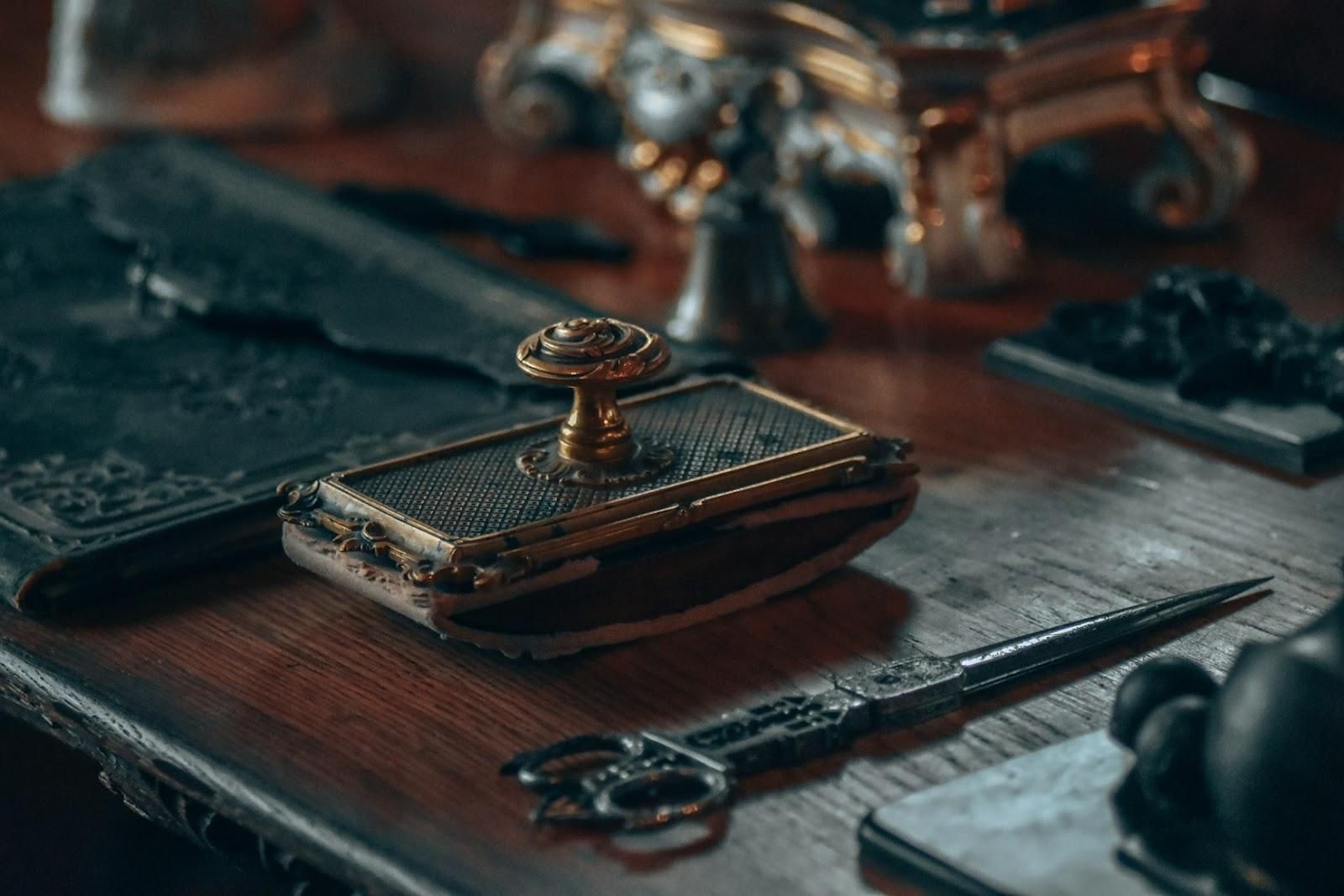
Fortunately, you can still see with your own eyes two of the inkwells that belonged to the man who penned nothing less than the Declaration of Independence. That’s right! The first, a ceramic inkwell shaped like Enlightenment philosopher Voltaire’s head, is housed at the Thomas Jefferson Foundation at Monticello. The second, made of bronze and engraved with "T. Jefferson, 1804," is part of the White House Collection.

6
Theodore Roosevelt's pince-nez glasses

Image: via Wikimedia Commons

Teddy Roosevelt is practically synonymous with his pince-nez glasses; even the giant sculpture of his face on Mount Rushmore shows him wearing them. But did you know they once saved his life? In 1912, while campaigning, Roosevelt was shot, but the bullet struck the steel case holding his glasses and didn’t penetrate it. Today, both the case and the 50-page manuscript he carried in the same pocket are on display at the Theodore Roosevelt Birthplace National Historic Site in New York City.

7
John F. Kennedy's rocking chair

Image: Abbie Rowe. White House Photographs. John F. Kennedy Presidential Library and Museum, Boston, Public domain, via Wikimedia Commons

President Kennedy’s rocking chair appeared in many photos of him with important visitors in the White House. Recommended by his doctor to ease his back pain, the iconic chair is now part of the collection at the John F. Kennedy Presidential Library and Museum.

8
George Washington’s Revolutionary War bedstead

Image: Wikimedia Commons

If you thought this list was just about small objects, think again. Two of George Washington’s folding field beds from the Revolutionary War have also been preserved. One is displayed at the Henry Ford Museum in Michigan, and the other can be seen at the Mount Vernon Museum in Virginia.

9
Franklin D. Roosevelt’s stamp collection

Image: Tolga deniz Aran

F. D. Roosevelt was an avid stamp collector, amassing a collection of over 1.2 million stamps. After his death, his family sold most of them, but some—especially those he received officially from foreign governments—are preserved at the Franklin D. Roosevelt Presidential Library and Museum in Hyde Park, New York. The museum also houses items related to his hobby, including a magnifying glass, a perforation gauge for measuring stamps, and his portable wooden stamp box.

10
George Washington’s dress sword

Image: Wonderlane

In addition to his dentures, Mount Vernon preserves many other personal items that belonged to George Washington. Among them are several of his swords, and it is believed that one of them may be the very dress sword he wore at his inauguration as the first American president in 1789!

History History 4 min read

Lands that were only dreams

Superior, Transylvania, Sequoyah, and other states that never were

Image: Chris Lawton

The map of the United States could have looked very different—perhaps with around 70 states, each having its own capital and constitution. For example, have you ever heard of the proposed states of Franklin or Westsylvania? And can you guess where Superior was supposed to be located? Let’s dive into 13 states that almost—but never—found a place on the map.

1
Superior

Image: Brian Beckwith

As we know, Michigan is divided into the Upper and Lower Peninsulas. The discussion about whether the Upper Peninsula should become its own state dates back as far as 1858.

During the 19th and 20th centuries, residents of the region proposed creating the State of Superior , named after the Great Lake that defines the region. Although the movement never gained enough traction, some people still support the idea today, even though Superior would become the state with the smallest population.

2
Jefferson

Image: Kirk Thornton

Jefferson was a proposed state, much like Washington was before it became a state. Picture this: a state straddling Northern California and Southern Oregon, rich in timber and minerals. This was the vision for Jefferson , first proposed in the mid-19th century and revived in 1941.

Residents even declared a symbolic "secession" and distributed pamphlets proclaiming their independence. However, World War II shifted priorities , and the movement eventually fizzled out.

3
Deseret

Image: Wolfgang Hasselmann

Mormon settlers had big dreams in 1849—they proposed Deseret , a massive theocratic state . The name, meaning "honeybee" in the Book of Mormon , symbolized industry and cooperation. But Congress wasn’t exactly buzzing with enthusiasm.

Instead, Congress created the smaller Utah Territory , which at the time included present-day Utah as well as parts of Nevada, Colorado, and Wyoming.

4
Sequoyah

Image: Nina Luong

In 1905, Native American tribes in eastern Oklahoma proposed the State of Sequoyah , named after the Cherokee scholar who created the Cherokee syllabary .

It was a bold move to create a Native-majority state. However, Congress chose instead to merge the area with Oklahoma Territory to form the state of Oklahoma . The constitution drafted for the proposed State of Sequoyah went on to influence the final Constitution of Oklahoma.

5
Lincoln

Image: Clark Van Der Beken

The proposed State of Lincoln had multiple identities. One version placed it in eastern Washington and northern Idaho. Although the name was intended to honor Abraham Lincoln, other names, such as Columbia and Eastern (East) Washington , were also considered.

Another proposal envisioned Lincoln in southern Texas. This version reportedly had a prepared constitution and a distinctive red flag featuring Lincoln’s face inside a yellow circle.

6
East and West Jersey

Image: Nick Fewings

Can you imagine two New Jerseys? Back in 1674, when the area was still a British province, New Jersey was divided into East Jersey and West Jersey , each with its own government and constitution.

But the separation lasted only 28 years . The territories were rejoined in 1702, and the first New Jersey state constitution wasn’t adopted until 1776, following independence from Britain.

7
Franklin

Image: Dan Mall

The State of Franklin was another plan, except this one worked, for a while. In 1784, settlers in eastern Tennessee had had enough with what they saw as North Carolina’s neglect. They declared independence and formed the State of Franklin , named after Benjamin Franklin, of course.

For four years, Franklin operated as a de facto state , complete with its own constitution and government. However, Congress refused to recognize it, and by 1788, the State of Franklin ceased to exist.

8
Transylvania

Image: Julia Volk

Transylvania (from the Latin for "beyond the woods" ) is more than just a remote land of vampire legends—it was also nearly the name of a short-lived American colony in what is now mostly Tennessee and parts of Kentucky.

In 1775, land speculator Richard Henderson struck a deal with the Cherokee to create the Colony of Transylvania , in parts of Kentucky, Tennessee, and Virginia. But Virginia and North Carolina declared the venture illegal. Still, the name lives on today in Transylvania University in Lexington, Kentucky.

9
Nickajack

Image: lauren barton

During the Civil War, Union sympathizers in northern Alabama, northern Georgia, and eastern Tennessee proposed the creation of the State of Nickajack . The name came from a Cherokee village, but the idea never gained much traction.

Today, the Nickajack Dam and Nickajack Lake reservoir mark areas that would have fallen within the boundaries of this proposed state.

10
Absaroka

Image: Mohan Nannapaneni

Have you ever heard of Absaroka ? During the Great Depression, residents of parts of Wyoming, South Dakota, and Montana proposed the creation of the State of Absaroka , named after the Crow Nation’s word for "children of the large-beaked bird."

The movement was largely a symbolic protest against federal neglect. Absaroka even had its own license plates and a self-declared "governor," but the state never came to fruition.

11
Westsylvania

Image: Isaac Wendland

Yet another -vania . In the late 18th century, settlers west of the Appalachian Mountains proposed the creation of the State of Westsylvania . Frustrated by neglect from eastern state governments—especially Virginia and Pennsylvania—they wanted a state of their own.

But like many other separatist efforts, the proposal was rejected by Congress and never became a reality.

12
Madison

Image: Library of Congress

Another president nearly had a state named after him—but didn’t. The name of the fourth U.S. president, James Madison, was once proposed for the area that is now part of the Dakotas.

In the late 19th century, residents of what is now southwestern North Dakota proposed the creation of the State of Madison . However, the idea faced a major hurdle: Congress was already considering dividing the Dakota Territory into two separate states. In 1889, North and South Dakota were admitted to the Union, and the Madison proposal was quietly shelved.

Explore more American facts

Choose your favorite category!

General
General

As American as apple pie—the very best America has to offer!

Culture
Culture

Delve into the astounding richness of American lore.

Geography
Geography

Hop in and explore vast and diverse American landscapes.

History
History

Discover the key moments that shaped the United States.