History History 3 min read

Everything has a secret to tell

Take a deep breath before reading these iconic landmarks’ untold stories

Image: Venti Views

America is filled with famous landmarks that everyone recognizes. But some of these places hold secrets known to only a few. For example, did you know that Niagara Falls can be turned off and on like a faucet? Or that a hidden social club exists inside New York’s Grand Central Station? Discover 12 of these incredible facts and impress your friends with your knowledge!

1
The Statue of Liberty’s color

Image: Pierre Blaché

We start our list with a moderately well-known fact: the Statue of Liberty’s beautiful emerald color is not original. Technically, it’s a sign of damage. While the statue's infrastructure is made of iron, its exterior is copper, which has turned green over time due to oxidation .

Fortunately, that same green coating now protects the statue from further damage and deterioration.

2
Grand Central Terminal’s hidden club

Image: David Vives

A busy train station may not seem like the ideal place for a social club, but that’s exactly the case with the Explorers Club. Operating for decades, this exclusive venue primarily serves locals, featuring a full gym, an indoor hard court, and even a smaller secondary court .

3
Gateway Arch’s time capsule

Image: Chris Hardy

This beloved St. Louis landmark holds a secret at its peak: a time capsule was placed inside the arch in 1965 , containing 762,000 signatures—many from students who attended St. Louis schools at the time.

The capsule is permanently welded inside the arch and will remain sealed for as long as the structure stands.

4
New York's High Court Building’s ball court

Image: Markus Spiske

New Yorkers seem to have a penchant for sports courts hidden on the top floors of iconic buildings—this one being the second on our list. The New York High Court Building is primarily a place for legal proceedings and bureaucratic work, but on its fifth floor, visitors will find a basketball court known as the "Highest Court in the Land."

5
The White House’s dentist

Image: Benyamin Bohlouli

It’s easy to imagine hallways and rooms filled with endless state secrets in the White House basement. But what most people won’t guess is that you can also find a dentist’s office, a carpenter’s shop, and even a bowling alley down there.

6
Niagara Falls is a huge faucet

Image: Tosab Photography

As strange as it sounds, this statement is true in a sense. The complex system of pumps and gates that administer the water of the Falls can be controlled by a central command.

In fact, part of Niagara Falls is even scheduled to be "turned off" in the coming years to replace some obsolete structures—just like a faucet.

7
Washington Monument’s Civil War graffiti

Image: Sonder Quest

Graffiti has been around all over the world, for a couple of centuries now. The Washington Monument was still under construction when the Civil War broke out, and Union soldiers stationed there carved their names and drew pictures onto the monument . These markings can still be seen today at its base.

8
Mount Rushmore’s hidden room

Image: Jéan Béller

One of America’s most famous landmarks hides a secret room known as the Hall of Records , which is filled with documents intended to preserve the nation’s history for future generations. This hidden chamber is accessed through a concealed door behind Abraham Lincoln’s ear.

9
Lincoln Memorial’s secret carvings

Image: Andy Feliciotti

Speaking of Lincoln, you’ll need a flashlight to spot this one—but it’s there. On the north wall stone of the Lincoln Memorial, the letters "EBL" can be seen carved . These initials stand for Evelyn Beatrice Longman, the artist who sculpted the memorial’s ornamental border.

10
Empire State Building’s secret floor

Image: Kit Suman

As it turns out, the Empire State Building has one more floor than the famous 102. This extra floor was originally constructed for building maintenance but now serves as an exclusive hotspot for celebrities, complete with an ultra-thin, knee-high railing separating observers from the sky surrounding them.

11
Brooklyn Bridge’s wine cellars

Image: Partha Narasimhan

Wine cellars are cold and dark places—just like the basements at the Brooklyn Bridge’s bases. This connection, now quite obvious, was made by the bridge’s engineer, Washington Roebling, who incorporated two full wine cellars into the bridge’s bases on each side and then rented the space to local businesses who needed the extra storage.

12
Disneyland’s secret members-only club

Image: Travis Gergen

If a trip to Disneyland isn’t enough of a Disney experience for you, there’s an exclusive club on the premises called Club 33 . This exclusive joint boasts an invite-only guest list, where members must pay anywhere from $25,000 to $100,000 to join, with annual membership dues ranging from $12,500 to $30,000. Do you think it’s worth it?

General General 3 min read

One-of-a-kind

The one thing these states can brag about (and no one else can)

Image: RDNE Stock project

Every state in the U.S. has its own personality, but some come with bragging rights no one else can touch. From deserts and diamonds to cave systems and cheese-making microbes, each of these states has a claim to fame that sets it apart. If you enjoy travel trivia, fun facts, or just knowing more about our big and quirky country, you’ll want to stick around for this one. Let’s take a lighthearted look at the states that are true originals.

1
South Dakota sits right in the middle of it all

Image: Intricate Explorer

Just outside the town of Belle Fourche, South Dakota, lies the geographic center of the United States when you include Alaska and Hawaii . It is not marked with neon signs or big crowds, but there is something satisfying about standing near the heart of the whole country. It feels like the center of gravity for the U.S.

2
Iowa is flanked by rivers on both sides

Image: Justin Wilkens

If you look at a map, you will see Iowa neatly tucked between two mighty rivers . The Mississippi River borders it to the east, and the Missouri River forms most of its western boundary. No other state can say that its entire east and west borders are made up of rivers. That gives Iowa a front-row seat to river life from both sides.

3
Kansas is flatter than a breakfast pancake

Image: Edson Saldaña

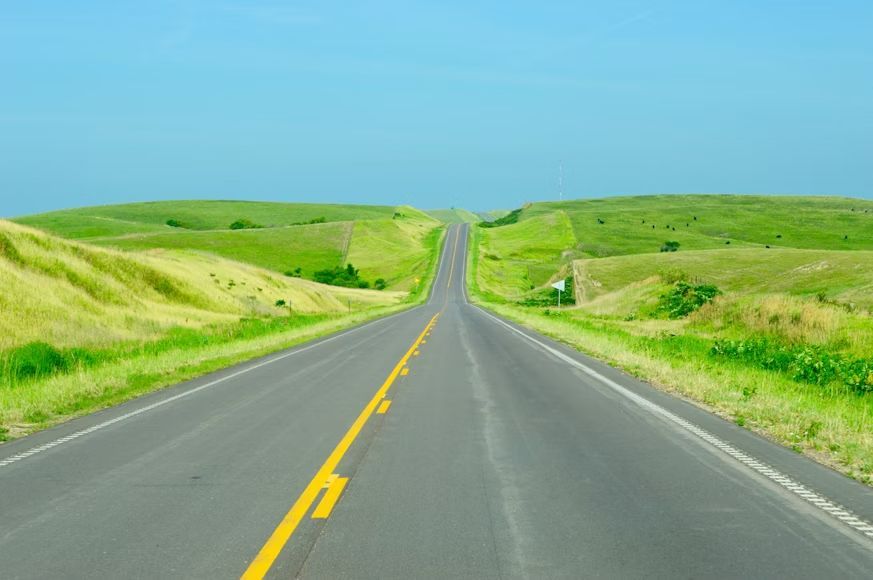
Believe it or not, a group of researchers once compared Kansas to a pancake and found that Kansas is actually flatter . This was not a joke. They used real measurements. If long, open roads and wide horizons are your thing, Kansas is the ultimate smooth ride.

4
Arizona has all the deserts in one place

Image: Keith Hardy

Arizona is not just dry, it’s uniquely arid. It is the only state that includes parts of nearly all of the major North American deserts . These include the Sonoran, Mojave, Chihuahuan, and Great Basin deserts. That makes it a desert lover's dream and a living science exhibit where four very different ecosystems meet in one sunbaked state.

5
Michigan lives and breathes freshwater

Image: Aaron Burden

Michigan has more freshwater shoreline than any other state in the country. It borders four of the five Great Lakes , features two peninsulas, and is even home to a floating post office that delivers mail by boat. If you enjoy water views and lakeside life, Michigan delivers the goods in a big way.

6
Connecticut gave counties the pink slip

Image: Rusty Watson

Unlike most states, Connecticut does not have county governments. The state decided back in the late 1950s and early 1960s to get rid of them entirely. Now, counties are just lines on a map and have no political power. If you live in Connecticut, you deal directly with your town or city. No middleman needed.

7
Delaware still uses ‘hundreds’ and no, not the money kind

Image: Gary Cole

In Delaware, land is still divided into areas called hundreds . These are old British-style subdivisions that originally represented areas able to support roughly 100 households. While they do not play a role in law or government today, the names still show up in property documents and tax records.

8
Kentucky hides the longest cave under its feet

Image: Joshua Sortino

Beneath Kentucky’s surface lies a giant underground wonder called Mammoth Cave. It holds the record as the longest known cave system in the world , with over 400 miles of mapped tunnels. That is a whole lot of rock and mystery. Whether you are into history, geology, or just cool natural landmarks, this cave system is something special.

9
Louisiana prefers parishes over counties

Image: Joe Lavigne

Louisiana does not have counties like the rest of the country. Instead, it has parishes , a term carried over from its French and Spanish colonial days. These parishes work the same way counties do elsewhere, but the name gives the state a unique cultural twist.

10
Montana provides the nation's platinum and palladium

Image: Calvin Chai

Montana is the only significant source of domestically mined platinum and palladium in the United States. These rare metals are used in things like jewelry, dental tools, and car parts. Tucked into its rugged mountains, Montana’s mines quietly produce some of the most valuable materials in the country.

11
Wisconsin has an official microbe, and it makes cheese

Image: Azzedine Rouichi

Of course, Wisconsin would go this route. The state named Lactococcus lactis as its official microbe. It is the helpful little organism behind the cheese-making magic. Without it, you would not have cheddar, Colby, or many other favorites. Leave it to the dairy state to give a tiny cheese-maker its moment of fame.

General General 3 min read

Animal masonry 101

Can you believe these 12 incredible structures were built by animals?

Image: Matthias Zomer

From forests to backyards, America is full of incredible animal-made structures that rival—and sometimes even surpass—human architecture. Bees craft intricate hexagonal hives, ants build elaborate underground colonies, and many other creatures create amazing structures without using any kind of blueprint. Take a look at these 12 remarkable constructions and be inspired by their ingenuity.

1
Beehives

Image: Meggyn Pomerleau

The first entry on the list goes to perhaps the most famous and finest example of animal architecture: the beehive. Built by incredibly industrious insects, beehives are among the most efficient structures in nature .

The regular hexagons provide the least-perimeter way to enclose infinitely many unit areas in the plane: the best way to separate the surface of their hives in equal parts all around, using the least possible total perimeter, thus reaching 100% efficiency in design.

2
Ant colony

Image: Morten Jakob Pedersen

If beehives aren’t the first thing that comes to mind when thinking about animal architecture, there’s a good chance you’re thinking of ant colonies.

Ants build the elaborate colony structure by hollowing out the area with their mandibles, grain by grain, without a blueprint, without a leader, and in total darkness . Unless the soil dries out dramatically, the chambers will keep their form.

3
Prairie dog town

Image: Moritz Kindler

These cute creatures excavate their homes by digging burrows into the ground, primarily in the Great Plains of North America. The region experiences extreme seasonal weather variations from season to season, requiring their homes to be built to withstand extreme temperatures, floods, and fires.

These underground "towns" have nursery rooms, pantries, living quarters, and temporary refuges —each smartly separated to serve a specific purpose.

4
Beaver dam

Image: Derek Otway

Another famous animal architect, the beaver, uses felled trees to build dams . These dams create still ponds where beavers can construct their winter homes, called lodges.

These creatures prepare for winter by covering their lodge with a fresh coat of mud, which hardens to create a barrier against the cold and predators.

5
Caddisfly larvae case

Image: Wolfgang Hasselmann

Caddisfly larvae construct protective cases using silk and whatever materials are available , such as sand, small stones, and plant debris.

These cases camouflage the larvae from predators and can be remarkably diverse in appearance, reflecting their creativity and resourcefulness.

6
Octopus den

Image: Serena Repice Lentini

It’s no secret that octopuses are incredibly intelligent animals, and their dens are proof of it. These clever mollusks use shells, stones, and even discarded human objects to reinforce their homes . Some species go a step further, decorating their dens with seaweed and other found materials.

7
Bagworm silk tent

Image: Maëva Vigier

Bagworms construct silk tents around themselves using bits of leaves, twigs, and other debris . These tents serve as mobile homes, providing protection as the insect feeds and grows.

Some species even camouflage their bags to blend into the environment, helping them avoid predators.

8
Osprey nest

Image: Jorge Coromina

Ospreys build massive nests in tall trees or on human-made structures near bodies of water. These nests are carefully constructed with sticks and lined with softer materials , creating a sturdy platform that can last for multiple breeding seasons.

9
Coral reef

Image: Hiroko Yoshii

Coral reefs are massive structures built by tiny coral polyps. These marine architects secrete calcium carbonate to form hard skeletons, gradually creating vast and complex habitats for a myriad of marine species. They are often referred to as the "rainforests of the sea" due to their biodiversity.

10
Spider web

Image: freestocks

Another famous architect from the animal kingdom, the spider, creates webs that serve as both homes and hunting tools . The silk used in these webs is incredibly strong, and different species produce a variety of designs, including sheets, orbs, and funnel shapes.

11
Swallow nest

Image: Tobias Arweiler

Swallows build cup-shaped nests that can house entire colonies , using mud pellets, usually attached to vertical surfaces like cliffs or man-made structures.

The construction is precise and stable, providing protection for their young against predators and environmental elements.

12
Burrowing owl burrow

Image: mana5280

As their name suggests, burrowing owls make their homes underground , often taking over burrows abandoned by prairie dogs or other mammals.

They use these subterranean homes to protect their young and hide from the heat of the day.

Explore more American facts

Choose your favorite category!

General
General

As American as apple pie—the very best America has to offer!

Culture
Culture

Delve into the astounding richness of American lore.

Geography
Geography

Hop in and explore vast and diverse American landscapes.

History
History

Discover the key moments that shaped the United States.