Geography Geography 5 min read

A guide to the Mother Road

Did you know Route 66 has a halfway point and a crater?

Image: madeleine craine

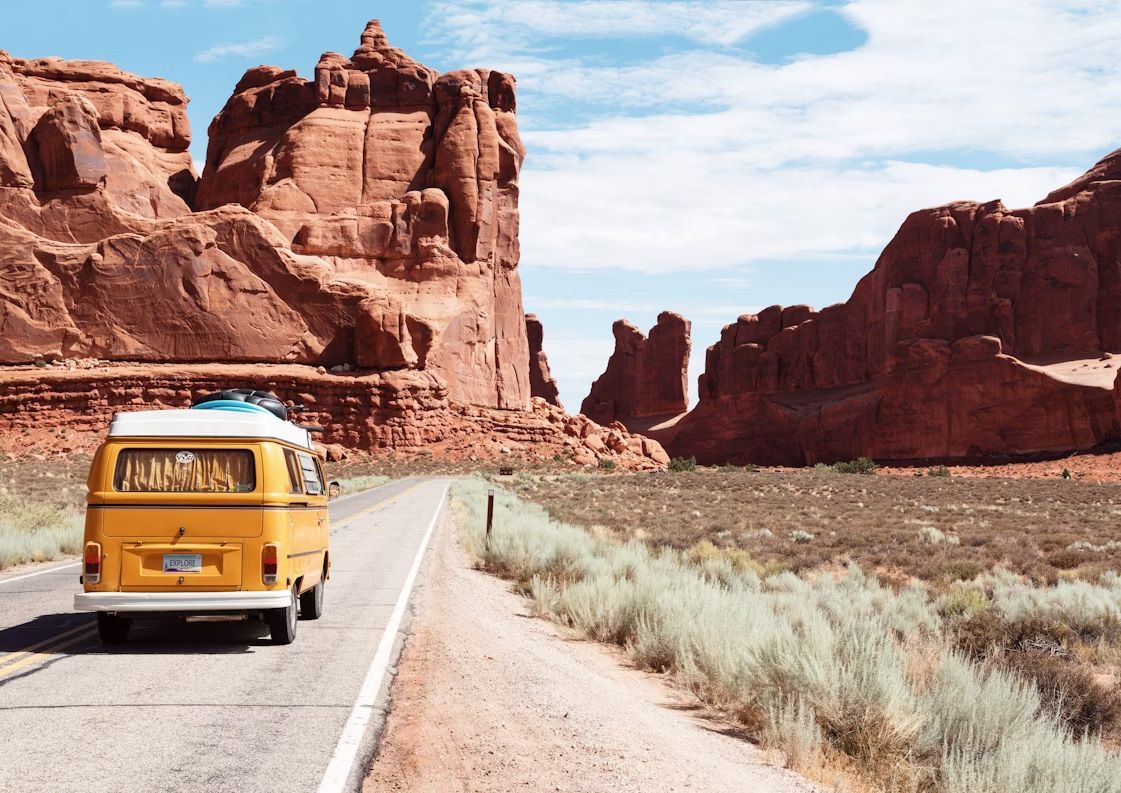
Route 66 is more than just a highway. If you do it right, it can be an epic journey through America’s past and present. With many roadside attractions, iconic landmarks, and mouthwatering pit stops, it’s the ultimate bucket-list road trip . Have you ever dreamed of kicking up dust in the desert or soaking in the nostalgia of the past? Well, we’ve put together 12 stops along the Mother Road that have something for everyone. So pack your snacks, gas up the car, and let’s hit the road. Ready to roll?

1
122 S. Michigan Ave.

Image: Allen Boguslavsky

Why not start the trip at the place where it all began? For Route 66, the beginning is right in the heart of Chicago , at 122 S. Michigan Ave. Look for the iconic pylon near the intersection of South Michigan Avenue and East Adams Street.

Fun fact: the Mother Road didn’t always start there. Back in 1926, Jackson Boulevard at Michigan Avenue was the official launch point for travelers!

2
Gateway Arch

Image: Intricate Explorer

Follow your adventure in St. Louis with the Gateway Arch, a towering 630-foot tribute to westward expansion. This stainless-steel beauty isn’t just a landmark, it’s an experience in itself.

Ride the tram to the top for jaw-dropping views of the Mississippi River and the city skyline. It’s the perfect way to set the tone for the rest of your journey.

3
Route 66 Drive-In Theater

Image: Tim Mossholder

Ready for some vintage vibes? Swing by the Route 66 Drive-In Theater in Carthage, Missouri. This blast from the past offers double features under the stars , just like in the good old days.

Opened in 1949, closed in 1985, and re-opened in 1998, this drive-in theatre has functioned ever since and plays two movies from Friday to Sunday every single week. Bring your lawn chairs and a cooler, or cozy up in your car for the full retro experience.

4
The Golden Driller

Image: Jametlene Reskp

Now it’s time to meet the Golden Driller, a 76-foot-tall oil worker who’s been standing proud in Tulsa, Oklahoma, since the 1960s.

It’s one of the largest freestanding statues in the country and a nod to Oklahoma’s rich oil history. At the base, there’s a sign that reads: "The Golden Driller, a symbol of the International Petroleum Exposition. Dedicated to the men of the petroleum industry who, by their vision and daring, have created from God’s abundance a better life for mankind." Strike a pose with this gentle giant, and you’ll feel downright tiny.

5
Route 66 Museum

Image: Carol Highsmith's America

For the following stop, you can take a break to explore the Oklahoma Route 66 Museum in Clinton. In it, you’ll be able to see artifacts, photos, and exhibits celebrating the history of the Mother Road.

Wander through rooms themed by decade, and you’ll feel like you’re traveling through time. From the Dust Bowl to the heyday of diners, this museum paints quite a vivid picture of Route 66’s golden era. And, of course, you can go by the gift shop to get a road trip memento.

6
Cadillac Ranch

Image: Heidi Kaden

If you’ve ever wanted to graffiti a Cadillac, this is your chance. Cadillac Ranch in Amarillo, Texas, features 10 half-buried cars sticking nose-first out of the ground. It’s an open-air art installation that’s as weird as it is wonderful.

Grab a can of spray paint (provided by friendly locals or your fellow travelers) and leave your mark. Just be warned, it might only last a day before someone else paints over it!

7
Route 66 Halfway Point

Image: Vicky McLain

Welcome to Adrian, Texas, the official halfway point of Route 66! You’re 1,139 miles from both Chicago and Los Angeles, so take a breath and celebrate!

The MidPoint Café is famous for its "ugly crust" pies. Don’t trust the name; they are actually delicious! It’s a perfect pit stop to recharge and think about the fact that you’ve conquered half of the Mother Road. Only halfway to go!

8
Meteor Crater

Image: John Ballem - a collection of personal photos

Arizona is home to some magical attractions, and Meteor Crater is no exception. This massive impact site, located near Meteor City, was created by a meteorite over 50,000 years ago . Standing on the rim and peering into the 560-foot-deep crater, you’ll feel like a tiny speck in the universe. The visitor center has some cool exhibits on space and meteors, which is perfect for science lovers or anyone who likes their roadside stops with a side of awe.

9
Old Trails Bridge

Image: Jimmy Whitson

Crossing the Colorado River into Arizona, the Old Trails Bridge in Topock is a picturesque reminder of Route 66’s early days. Though it’s no longer open to traffic , it’s a popular photo spot for travelers.

The rusted steel beams and sweeping desert views will give you a beautiful moment. Pause here, take in the history, and imagine the countless cars that once went across its span.

10
Burger Hut

Image: Haseeb Jamil

Needless, California, may be small, but it’s big on charm, especially at Burger Hut. This unassuming little eatery is beloved for its old-school burgers, fries, and milkshakes. It’s the kind of place where the food is made with love , and the portions are hearty. Don’t take our word for it; just go try it!

After hours on the road, there’s nothing better than a juicy burger and a chance to stretch your legs. This spot is a gem along Route 66!

11
Hollywood sign

Image: Scott Greer

As you approach the end of Route 66, why not take a detour to see the world-famous Hollywood Sign? Perched on the hills overlooking Los Angeles, it’s a symbol of dreams and stardom .

Take a hike to the best viewpoints for some exercise (and epic photos, of course). Sure, it’s a bit off the beaten path, but what’s a road trip without a side quest?

12
Santa Monica Pier

Image: Joel Mott

You’ve made it! The Santa Monica Pier marks the official end of Route 66 . With its iconic Ferris wheel, arcade games, and ocean views, it’s the perfect spot to celebrate completing your journey.

Now you’re done, dip your toes in the Pacific, grab a cone of soft-serve, and reflect on all the memories you’ve made along the way. The Mother Road may end here, but the stories you’ve collected will last a lifetime.
General General 4 min read

10 things you won’t believe are banned in the U.S.

Image: Tara Winstead

America is famous for its love of freedom, yet a few peculiar and oddly specific rules survived in dusty town codes and old state books. Some were written to solve long-forgotten problems; others simply remained by accident. What they all have in common is that they are a reflection of our quirks and contradictions. From outlawed snowballs to forbidden confetti, these 10 real bans prove that, in the land of the free, common sense sometimes just goes and take a coffee break.

1
Snowball fights

Image: Arina Krasnikova

It may sound like the premise for a coming-of-age comedy film, but it’s absolutely true: in Wausau, Wisconsin, throwing a snowball is technically against the law. The city once grouped snowballs in the same category as "stones and missiles," as if every kid with a pair of mittens were a potential threat to public safety. Of course, local police don’t patrol sledding hills looking for offenders anymore. The rule mostly lives on as a charming reminder that even winter fun can end up in the law books.

2
Camel hunting

Image: Shaun Danny

Camels in Arizona? Well, technically. Back in the mid-1800s, t he U.S. Army brought camels to the Southwest, hoping their strength and stamina would make them the perfect means for desert transport. The experiment didn’t last—soldiers preferred their mules—but the camels did, wandering off into the wild. To protect the survivors, the State of Arizona outlawed camel hunting, a law that still stands today. So if you ever spot one, grab your camera, not your hunting license!

3
Texting while walking

Image: Elizabeth Woolner

Crossing the street with your eyes glued to your phone is the 21st century’s twist on jaywalking. In Honolulu, Hawaii, that nasty habit can cost you up to $99, thanks to a local ordinance meant to curb "distracted walking." Officials say it’s about protecting pedestrians from accidents; residents jokingly call it "the eyes-up law." Whether you see it as common sense or overreach, the rule makes one thing clear: the text, meme, or emoji can wait until you’re safely on the other side.

4
Apple pie must come with ice cream

Image: Patrick Fore

Here’s a rule everyone can get behind. Vermont, proud home of rolling orchards and autumn harvests, officially crowned apple pie as its state dessert. But lawmakers didn’t stop there; they added a charming twist, recommending that each slice be served "in good faith" with a scoop of vanilla ice cream, a piece of sharp cheddar, or a glass of cold milk. It’s less a regulation and more a warm invitation to enjoy a simple American treat. Yes, the law can sometimes be fun and downright delicious!

5
Bear wrestling

Image: Florian Schindler

Believe it or not, there was a time when people thought wrestling a bear was a good idea. Traveling shows and roadside attractions once featured men squaring off against hulking bruins for cheers and pocket change. Eventually, Alabama decided it was a spectacle best to leave it in the past. In 1996, the state officially banned bear wrestling, making it illegal to train, promote, or even sell tickets to such events. Today, the law stands as a small but noble victory for animal welfare. As for the bears? They walked away undefeated, every single one of them.

6
Password sharing

Image: cottonbro studio

Before Netflix made it official, Tennessee was already ahead of the curve. Back in 2011, the state passed a law making it illegal to share passwords for paid streaming services. The rule was originally meant to stop hackers from selling stolen logins, but it ended up being a cautionary tale for the streaming wars to come. Technically, lending your password to a friend could cost you $2,500 and even land you a year in jail. What once seemed overcautious now feels oddly prophetic, almost like Tennessee read the fine print of the future.

7
Dueling

Image: Leon Kohle

If you’ve ever challenged someone to a duel—yes, the kind with pistols and a handshake at dawn—you can forget about running for office in West Virginia. The state’s constitution, written in the 1800s, includes a clause that permanently bars any duelist from holding public office. The idea was to keep gentlemen of "honor" from turning government into a shooting gallery. More than a century later, the law remains untouched, a relic of a time when reputations were defended at ten paces.

8
Roller-skating

Image: Harrison Haines

Can you imagine roller-skating being banned in your town? Back in the 1930s in Biddeford, Maine, sidewalks were sacred ground for Sunday strolls, not racetracks for daredevils on wheels. So, the city downright prohibited skating and biking on sidewalks. Believe it or not, the rule, established in a slower era when the biggest traffic hazard downtown wasn’t a speeding car, but a kid on skates, still lingers in the city code today.

9
Fishing with your hands

Image: Patti Black

Think you’re tough enough to catch a catfish with your bare hands? In Indiana, that risky stunt—known as "noodling"—will earn you more than bragging rights; it could get you fined. The practice involves reaching into murky holes and hoping the fish bites, but lawmakers decided it was safer for everyone if they didn’t. The ban protects catfish during breeding season and probably saves a few bold fishermen’s lives. So, if you’re visiting Indiana and are feeling adventurous, bring a rod instead!

10
Confetti

Image: jameson wu

Mardi Gras in Mobile, Alabama, bursts with color, music, and flying beads, but there’s one thing you won’t see floating in the air: confetti or silly string. The city banned both to keep its historic streets clean after the celebrations. The rule might sound like a party pooper, but locals don’t mind. They’ve turned cleanup into an art form, celebrating with floats, jazz bands, and smiles instead of streamers. After all, the joy of Mardi Gras isn’t in what you toss but in the rhythm, the laughter, and the sparkle that doesn’t need sweeping up.

General General 6 min read

Into the wild

Boost your animal instincts with 10 fascinating mammals that roam America

Image: christie greene

Mammals form one of the greatest classes of vertebrate animals. There are more than 5400 known species of mammals in the world, and more than 400 of these species are found in the United States. From terrestrial to aquatic, carnivorous to herbivorous, we have some of the most interesting mammals on the planet. In this article, we have chosen 10 animals that, due to their special characteristics, are already an essential part of our culture. Can you guess which ones they are?

1
Grizzly Bear

Image: Joshua J. Cotten

Grizzly bears ( Ursus arctos horribilis ) are one of the most famous North American mammals, but do you know why they are called that? The grizzly bear is a subspecies of the brown bear. However, although grizzlies are mostly brown, their fur can appear white-tipped or grizzled , which explains their name.

The grizzly bear once lived throughout much of the North American West. Unfortunately, the arrival of Europeans gradually drove it from its original habitat, considerably reducing its population. In 1975, they were listed as threatened under the U.S. Endangered Species Act, and much has been done since then to protect the species. Today, grizzlies can still be found in parts of Wyoming, Montana, Idaho, Washington, and the Alaskan wilderness. They are also one of the most iconic residents of Yellowstone National Park.

2
Gray Wolf

Image: Yannick Menard

We all know that wolves are legendary for their eerie howl, but there are many other interesting facts about this peculiar animal. Gray wolves ( Canis lupus ) are the largest members of the dog family and are native to North America and Eurasia. The size of an adult gray wolf is similar to that of an average dog and it can weigh up to 145 pounds. However, their tracks would outshine those of any dog, as they measure about 5 inches long by 4 inches wide.

Wolves live and hunt in packs of 6 to 10 animals. They are known to travel great distances, even covering 30 miles in a single day. In the United States, gray wolves were hunted to near extinction, although some populations survived and others have since been reintroduced. Today gray wolves can be found in areas such as the Great Lakes states of Minnesota, Wisconsin, and Michigan, the northern Rocky Mountains region, and the northwest.

3
North American River Otter

Image: lovelooking

The North American River Otter ( Lontra canadensis ) is a species of semi-aquatic, carnivorous mammal endemic to the North American continent that can be found along the coasts and rivers of the United States and Canada. Because they are very susceptible to environmental pollution, their population has been reduced considerably in recent years.

It is a mostly nocturnal animal, often seen at dusk or dawn. During the day it takes refuge in burrows with an underwater entrance that leads to a nest chamber lined with plant material and hair. North American River Otters are robust (11 to 31 pounds) and feed on fish and other aquatic prey, such as turtles, frogs, and crabs.

4
Red Fox

Image: Jeremy Hynes

The red fox ( Vulpes vulpes ) is a species of mammal in the canid family. It is the most abundant fox species in the northern hemisphere and can be found in many national parks across the country. As its name suggests, its fur is reddish in color. The tips of the ears and the ends of the legs, however, are black. They have a bushy tail whose tip is usually white, as is their belly.

Although classified as a carnivore, the red fox is actually an omnivore and, above all, a great opportunist. They are astute, have excellent eyesight, and have a keen sense of smell and hearing. They can hunt prey of a wide variety of sizes, from insects and worms to small mammals, birds, and fish. They also feed on certain vegetables, berries, and fruits.

5
Mountain Lion

Image: Robert Sachowski

The cougar ( Puma concolor ), also known as the mountain lion, is a mammal native to the Americas. These large, tan cats are found from the Yukon in Canada to the southern Andes Mountains and Patagonia in South America. In the United States, mountain lions can be found mainly in the western part of the country. However, because of their solitary nature and constant threats from humans, it is difficult to estimate exact population numbers.

Mountain lions are slender and agile felines that can adapt to different conditions and environments. They are strict carnivores and have extraordinary vision and acute hearing, which allows them to capture almost any animal, from insects to squirrels, beavers, elk, and deer.

6
North American Beaver

Image: kidmoses

Beavers are known to be one of the only animals that can affect the ecosystem around them, building watertight dams that help preserve water in streams and rivers. The North American beaver ( Castor canadensis ) is the largest rodent in North America and one of the largest in the world —it can weigh between 24 and 71 pounds! The species is widely distributed throughout the continent, from northern Canada to northern Mexico.

The North American beaver's coat can range from dark brown to reddish brown, and its most distinctive feature, a flattened paddle-shaped tail, allows it to swim. It is perfectly adapted to semi-aquatic life; its ears and nose have valves that close when submerged, and it can close its lips behind its prominent incisors to cut wood underwater.

7
Hawaiian Monk Seal

Image: Sebastian Coman Travel

The Hawaiian Monk Seal ( Neomonachus schauinslandi ) is a species native to the Hawaiian Islands. With its friendly face and long whiskers, it is perhaps one of the most endearing mammals that can be found in our country. Unfortunately, this seal species is endangered because of the large amount of chemical waste produced by the fishing industry on the reefs and beaches of the northern Pacific Ocean.

The Hawaiian Monk Seal is usually solitary but is always seen accompanied by other specimens. It is known to be piscivorous, that is, it feeds mainly on fish and other marine creatures, such as crustaceans and some species of mollusks. Since it is a predator by nature, when hunting it makes the most of its length (approximately 7 feet) and its large body (between 300 to 600 lb) to catch its prey.

8
American Red Squirrel

Image: Rusty Watson

The American red squirrel ( Tamiasciurus hudsonicus ) lives in the United States and much of Canada. It is a rodent mammal easily recognized for its deep reddish fur, long bushy tail, and prominent lower teeth. It can be differentiated from other North American squirrel species because of its smaller size, 11 to 14 inches.

American red squirrels normally live in the shady areas of coniferous forests and are primarily granivores. They feed on seeds, pine cones, nuts, fruit, and occasionally insects, eggs, and birds. It is mainly active in trees but also swims freely, using its tail as a rudder to change its direction.

9
Elk

Image: Judy Beth Morris

Elk ( Cervus canadensis ), also known as wapiti in several Native American cultures, is a species of deer that lives in North America, Central and East Asia. Today, most elk in our country are found primarily in the West, especially in mountainous regions such as Wyoming's National Elk Refuge and Yellowstone National Park. Some eastern states have also reintroduced small herds into natural forest areas.

The most prominent feature of elks is their massive antlers. Each March they shed their antlers, which begin to grow back in May to be ready for the breeding season in late summer. During this time the bellowing of the males echoes through the mountains, announcing the violent battles that serve to decide who mates with whom. The males with the largest antlers, usually the oldest, often win these duels and get to dominate the herd.

10
American Bison

Image: Stephen Leonardi

The American bison is a true symbol of American identity. Not only is it the largest mammal in North America, it is also the national mammal of the United States. In addition, it's one of the greatest conservation success stories of all time.

In prehistoric times, there were millions of specimens of American bison ( Bison bison ) roaming our territory. But by the late 19th century, there were only a few hundred left. Fortunately, thanks to the efforts of several organizations and individuals, the species was reintroduced and today it can be found in a few national parks and reserves as well as in the wild.

Explore more American facts

Choose your favorite category!

General
General

As American as apple pie—the very best America has to offer!

Culture
Culture

Delve into the astounding richness of American lore.

Geography
Geography

Hop in and explore vast and diverse American landscapes.

History
History

Discover the key moments that shaped the United States.