General General 4 min read

Cash curiosities

What would you do with a $10,000 bill? 10 rare facts about US money!

Image: Photo By: Kaboompics.com

While cash is becoming less common, there's no denying the economic and historical value of banknotes and coins. That's why so many people collect them! You might think you know a lot about the money we use every day, but there are plenty of hidden details and surprising facts that most people don't realize. From a $10,000 bill featuring Salmon P. Chase to coins with unexpected features, join us as we uncover 10 fun facts about US currency that just might surprise you!

1
$10,000!

Image: Eyestetix Studio

Did you know that, for a time, there was a $10,000 bill? That's right! The bill featured the portrait of Salmon P. Chase, President Lincoln's Secretary of the Treasury, and it was the highest denomination of US currency ever to be publicly circulated! While there was also a $100,000 bill, the latter was only used for large transactions between Federal Reserve Banks.

2
The first President on a coin

Image: Sebastian Enrique

We're totally used to seeing Abraham Lincoln's face on a penny, but that wasn't always the case.

Lincoln's image first appeared on the penny in 1909 to commemorate the 100th anniversary of his birth, making him the first US president to appear on a coin, an honor befitting our great Honest Abe! More than 115 years have passed since that addition, and his face is still featured on the iconic penny.

3
Silver pennies

Image: Josh Appel

In addition to featuring Abraham Lincoln's face, pennies are famous for their classic copper color. However, there was one year when the penny took on a different hue.

During WWII, a copper shortage occurred, hindering the usual production of pennies. For that reason, in 1943, pennies were made of steel coated in zinc, giving them a silver color and making them closely resemble dimes.

4
2 and 3 cents?

Image: Towfiqu barbhuiya

Did you know that, in the 19th century, the US had 2- and 3-cent coins? That's right! The 2-cent coin was minted from 1864 to 1873. On the front, it featured a shield symbolizing the Union during the Civil War . On the reverse, it bore the phrase "In God We Trust," making it the first coin to use the motto . The 3-cent coin had two versions: the silver 3-cent coin (1851–1873) and the nickel 3-cent coin (1865–1889).

5
Long lifespan
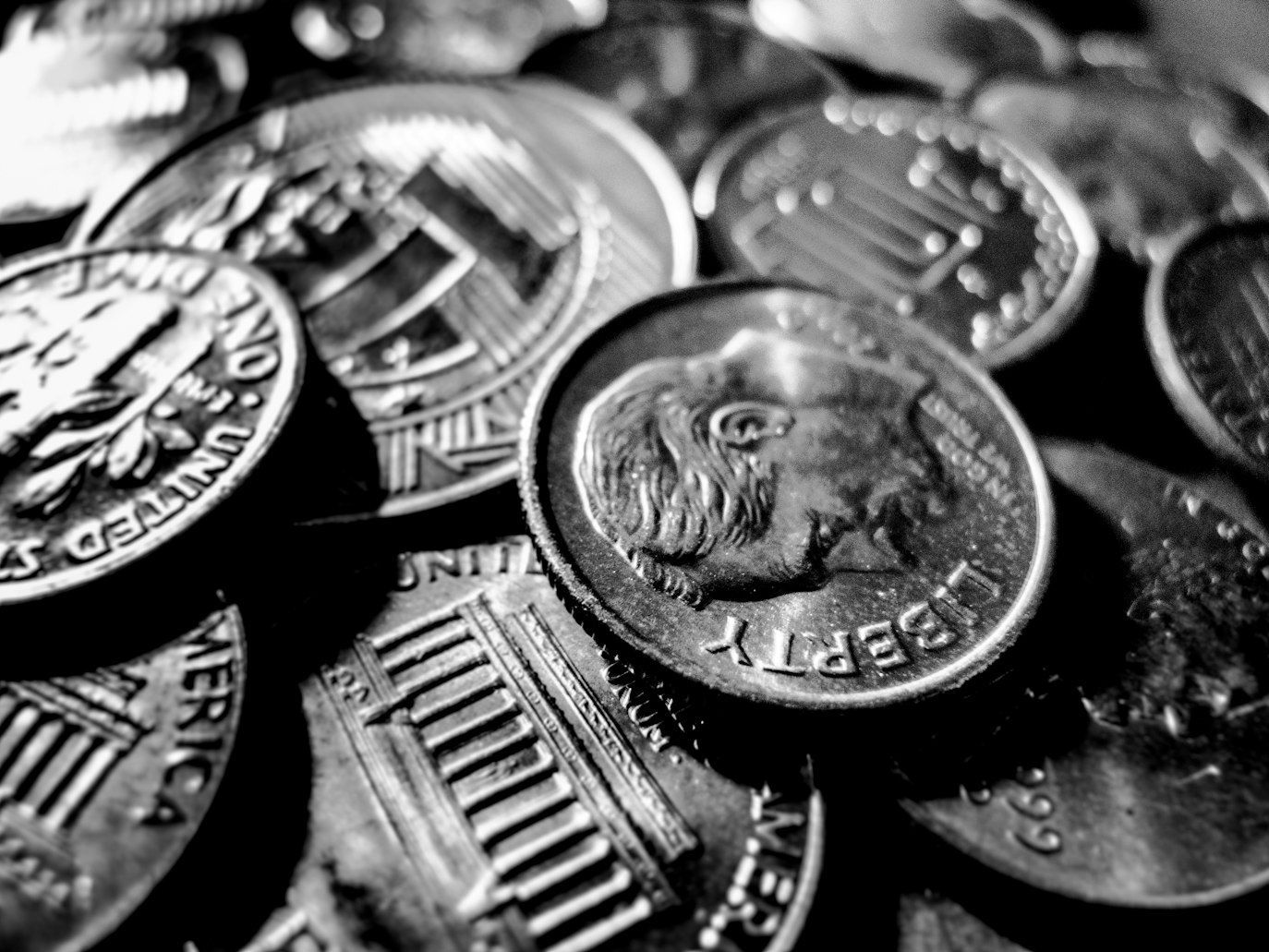
Image: Shot by Cerqueira

While each coin is used with a different frequency, the average lifespan of a coin can be as long as 40 years ! Just think about all the places and situations it might pass through during that time. Of course, the more a coin circulates, the quicker it will wear down. That’s why the penny has the shortest lifespan , lasting about 25 years on average.

6
In God We Trust

Image: Kelly Sikkema

"In God We Trust" is not only the official motto of the United States (and the state of Florida), but also the phrase that appears on all US currency currently in circulation. But how long has this phrase been there?

"In God We Trust" first appeared on some coins during the Civil War, starting with the aforementioned 2-cent piece. By 1938, the motto appeared on all US coins, but it wasn't until 1955 that President Eisenhower signed a law requiring "In God We Trust" to be included on all US coins and paper money.

7
Precious metals

Image: Jingming Pan

Today, US coins are primarily made of zinc, copper, and nickel. However, back in the early days of the US Mint, things were quite different. In the past, US coins were made not just of copper, but also of silver and even gold!

Over time, using those materials for coins became too expensive, and production shifted to more affordable metals such as zinc and nickel.

8
Safety edges

Image: Joshua Hoehne

When coins were made of precious metals like gold and silver , there was always the risk that someone might tamper with or shave the edges to extract the valuable material. Fortunately, the brilliant Isaac Newton came to the rescue. He introduced the clever idea of adding reeded edges to coins, which helped protect them from opportunistic tampering. With these marked edges, any shaving of the coin would be immediately noticeable. Pretty smart, right?

9
The most coins in the world

Image: Sarbasri Bhaumik

The US Mint manufactures billions of coins each year for circulation, and while that’s nothing new, there’s something about it that might surprise you: the United States is actually the world’s largest producer of coins . No other country makes more!

Pennies, nickels, dimes, and quarters are produced in large quantities every day. But that’s not all—dollar coins and special collectors’ coins are also minted, though in much smaller amounts.

10
"Paper" currency

Image: Adam Nir

Our paper money isn’t actually made of paper . It’s composed of 25% linen and 75% cotton. This blend gives US bills greater strength and flexibility, making them not only more durable but also more difficult to counterfeit. Plus, if you accidentally toss a buck in the washing machine, there’s a good chance it’ll come out just fine!
History History 5 min read

Stages that made history

Were you there? 10 legendary music concerts held in the U.S.

Image: Johannes Havn

Some performances stay with us forever. Moments like Jimi Hendrix setting his guitar on fire, Prince playing Purple Rain in the pouring rain, or The Beatles being drowned out by the roaring crowd at Shea Stadium are etched in the minds of millions. Some people witnessed them live, while others saw them in documentaries or YouTube videos that continue to amass views decade after decade. Regardless of the medium, generations agree that these 10 performances are among the most unforgettable shows ever staged in the US.

1
The Beatle’s Shea Stadium Concert

Image: Fedor

The Beatles couldn’t hear themselves over the overwhelming roar of the crowd during their first U.S. performance. The concert that the band from Liverpool gave at Shea Stadium in the summer of 1965 made history. It drew 55,000 fans—the largest rock concert audience at the time—and marked the first time a rock band played in a large stadium.

This event set a new standard for live music performances, highlighting the need for stadium sound systems capable of supporting massive concerts—since the one used that day was rudimentary. Though the band arrived by helicopter, sparked a frenzy of Beatlemania hysteria, and delivered a performance that would be rewatched for decades, they played only 12 songs in just 30 minutes .

2
1985’s Live Aid

Image: Andreas Talseth

Did you know that Phil Collins insisted on performing at both the U.K. and U.S. venues on the same day for 1985’s Live Aid? He boarded a Concorde jet to fly from Wembley Stadium to JFK Stadium in Philadelphia, where the U.S. leg of the famine relief fundraiser for Ethiopia was taking place.

The event was broadcast in 150 countries and reached nearly 1.9 billion people. The U.S. stage of Live Aid raised over $125 million and set the standard for large-scale charity concerts, inspiring similar events in the years that followed. Madonna, Bob Dylan, Mick Jagger with Tina Turner, Duran Duran, and Eric Clapton were just a few of the stars who performed that day.

3
Bob Dylan at Newport Folk Festival

Image: Nikoloz Gachechiladze

The 1965 Newport Folk Festival will always be remembered as the day Bob Dylan "went electric." His decision was controversial—he had long been associated with folk and blues, and his unexpected leap into rock divided the audience, with some cheering and others booing. Some believe the booing was directed at the poor sound quality rather than his choice to go electric. Regardless, Dylan left the stage after just three songs .

This moment is seen as a pivotal merger of folk and rock music. Afterward, Dylan fully embraced rock, releasing albums that included his hit "Like a Rolling Stone."

4
Simon & Garfunkel’s Concert in Central Park

Image: David Vives

In September 1981, Simon & Garfunkel reunited at Central Park in New York for their first performance together in over a decade. The duo had publicly announced their breakup in 1970, after friction and disagreements that had forced them apart. Their immense popularity drew a crowd of half a million people to Central Park to witness the event.

The duo performed some of their biggest hits along with a few of Paul Simon’s solo songs. The concert was a benefit to raise funds for the park’s restoration. It was broadcast live, and the recording was later released as a live album . The event reignited their popularity and led to a successful reunion tour.

5
The Allman Brothers Band’s Fillmore East Concerts

Image: Pixabay

During the spring of 1971, The Allman Brothers Band performed for three nights at the Fillmore East in New York City. These performances were recorded and released as the live album At Fillmore East , which became one of the greatest live albums in rock history.

What made these recordings particularly compelling for fans was the inclusion of extended jam versions of songs like "Whipping Post," "You Don't Love Me," and "In Memory of Elizabeth Reed." The band’s improvisational skills and seamless fusion of blues, jazz, and rock made this weekend in New York a legendary and widely acclaimed performance.

6
Johnny Cash at Folsom Prison

Image: M Shiva

In 1968, Johnny Cash made a decision that would revive his career and solidify his image as both empathetic and rebellious. Following a decline in popularity and struggles with addiction, he arranged a performance for the inmates at California’s Folsom Prison, about which he had written the hit Folsom Prison Blues years earlier.

Cash had played in prisons before, but this time, he chose to record it. The resulting album captured the raw energy of his direct engagement with the audience. At Folsom Prison became a massive success, marking the first in a series of prison concerts that would go on to become some of his best-selling records .

7
The Last Waltz of The Band

Image: William Krause

The Last Waltz was billed as The Band’s farewell concert , designed as a celebration of their remarkable career. Filmed by Martin Scorsese, the event featured an all-star lineup of guest musicians, including Bob Dylan, Joni Mitchell, Van Morrison, Muddy Waters, and Ringo Starr—just to name a few.

Held in 1976 at San Francisco’s Winterland Ballroom, the concert was later released as a documentary film , becoming one of the greatest concert films of all time. With its chandeliers and grand ballroom atmosphere , The Last Waltz set a new standard for farewell concerts.

8
Prince’s Super Bowl Halftime Show

Image: Daniel Robert Dinu

Many will always remember when Prince performed "Purple Rain" in the pouring rain during the 2007 Super Bowl Halftime Show . Despite the adverse weather, he commanded the "P"-shaped stage at Miami’s Dolphin Stadium during the break in the game between the Colts and the Bears.

He opened with his anthem "Let's Go Crazy" and included covers of songs by Bob Dylan and Foo Fighters. Legend has it that before the show, Prince was asked if he was worried about performing in the rain. His alleged response? A playful, " Can you make it rain harder ?" He then stepped out and delivered one of the greatest halftime shows in history.

9
Jimi Hendrix at the Monterey Pop Festival

Image: mirkosajkov

Until the Monterey Pop Festival in 1967, Jimi Hendrix had yet to break through in the US. It was none other than Paul McCartney who convinced organizers that the festival would be incomplete without the rising star.

American audiences were introduced to Hendrix’s guitar wizardry at this concert, where he showcased his newly released album Are You Experienced. The moment that cemented him as a force to be reckoned with came during a dramatic rendition of "Wild Thing," when he set his guitar on fire before smashing it.

10
Woodstock Music and Art Fair

Image: PeterKraayvanger

Finally, we can’t overlook the legendary Woodstock Music and Art Fair, forever known simply as "Woodstock." Held on a dairy farm in Bethel, New York, the festival became a symbol of the 1960s counterculture . Nearly half a million people gathered for this three-day event, which was originally planned as a profit-making venture but turned into an open festival when the crowds became overwhelming.

The lineup featured many stars who became emblems of the era, including Jimi Hendrix, Janis Joplin, The Who, Santana, and Joe Cocker, among others. Despite its iconic status today, Woodstock faced challenges such as food and water shortages, heavy rain, and overwhelmed medical services. Although the festival initially resulted in a financial loss , the costs were eventually recovered through profits from the film and soundtrack releases.

Culture Culture 5 min read

The top 12 most beloved cartoon characters in comic strip history

Image: Elsa Tonkinwise

Comic strips are way more than just cute cartoons on a page—they’ve been the heartbeat of American newspapers for decades. Morning routines often aren’t complete without flipping to the "funnies." In just a few panels, they manage to bottle up humor and creativity while reflecting everyday life in ways that feel both simple and profound. For generations of readers, these characters have grown into familiar companions, as real and reliable as neighbors down the street. What follows is a look back at some of the most beloved comic strip icons—characters whose charm hasn’t faded with time.

1
Thelma from The Family Circus

Image: Angel Sanchez

Here’s a little bit of trivia: cartoonist Bil Keane didn’t just imagine Thelma—he sketched her straight from life, inspired by his own wife. Far from being a background character, she stands as an anchor in a house full of wild little adventurers. College-educated and quick on her feet, she is the quiet balance that keeps the comic’s playful family from tipping over.

Since its debut in 1960, fans of The Family Circus have seen in Thelma not just a mother, but the steady rhythm that turns chaos into charm. She reminds everyone that even in the middle of a circus, there’s always someone holding the tent poles steady.

2
Snoopy from Peanuts

Image: somecomputer

What if a simple old beagle could slip into the role of a daring fighter pilot or a famous novelist without ever leaving his doghouse? That’s the magic of Snoopy.

From the 1950s onward, Charles Schulz gave this iconic, innocent dog a wildly imaginative life, where a simple nap on the roof could turn into a trip across the skies. He rarely speaks, yet every tilt of his ear and twitch of his eyebrow says more than words ever could. Snoopy shows readers that the biggest adventures often happen in our heads, proving that silence can tell a story louder than any punchline.

3
Garfield

Image: Jim Davis, Public domain, via Wikimedia Commons

Who would have guessed that a fat, sleepy cat introduced in 1978 would become one of the sharpest minds in comic strip history? Garfield never bothers chasing mice or protecting the house—he lets others do the hard work while he perfects the art of comfort.

Fueled by lasagna and armed with sarcasm, he turns laziness into a lifestyle. His famous dislike of Mondays isn’t just a joke—it’s a philosophy. Why suffer through the grind when you can nap through it? In his own sly way, Garfield teaches readers that brains sometimes triumph over brawn, especially when pasta is involved.

4
Calvin from Calvin and Hobbes

Image: Michał Turkiewicz

What happens when childhood curiosity meets mischievous behavior? Calvin happens. Bill Watterson’s rebellious and cynical six-year-old, born in the 1980s, can transform an ordinary backyard into a galaxy of adventures.

One moment, he’s a space explorer dodging aliens; the next, a philosopher debating life with a stuffed tiger. All his alter egos are playful but also surreal monuments of imagination. Beneath the pranks and wild schemes, Calvin reminds us that messy questions often lead to the brightest discoveries.

5
Wednesday from The Addams Family

Image: Jon Tyson

Imagine a child who never giggles at the obvious but instead tilts her head and asks the questions no one else dares. That’s Wednesday. When Charles Addams first sketched her in the 1930s, she wasn’t just another character in a gothic family—she was the sharp thinker in braids.

While her relatives reveled in the bizarre, Wednesday cuts straight to the harsh reality with calm precision. Her curiosity is fearless, her observations unflinching, and her wit so dry it makes readers smirk. In a household full of quirks, she is the quiet compass pointing toward reason.

6
Nancy Ritz from Nancy

Image: Tip Top Comics / United Features / Ernie Bushmiller, Public domain, via Wikimedia Commons

Long before "less is more" became a fashion motto, Ernie Bushmiller’s Nancy was already proving the point. With just a few lines, Bushmiller built a character who could provoke laughs sharper than most elaborate gags. Nancy’s jokes landed fast, like little surprise jabs, and her clean, minimalist style made her humor feel universal. Decade after decade, her zingers have stayed as fresh as if they were written yesterday.

7
Popeye the Sailor Man from Thimble Theatre

Image: E. C. Segar, Public domain, via Wikimedia Commons

Believe it or not, a cartoon sailor managed to change America’s dinner plates. When Popeye appeared in 1929, kids suddenly wanted to eat spinach, and sales of the leafy green soared by nearly a third.

With his anchor tattoos, squinty eye, and gravelly mumble, Popeye wasn’t exactly polished—he was tough, funny, and unforgettable. Every can of spinach he cracked open turned into instant muscle, proving that strength, humor, and even vegetables could be downright heroic.

8
Dick Tracy

Image: R Jangaard

Imagine picking up a newspaper in 1931 and spotting a hard-boiled detective with a futuristic radio strapped to his wrist. For readers of the day, it looked like pure science fiction. Chester Gould’s Dick Tracy wasn’t only solving crimes—he was predicting the kind of technology that wouldn’t appear in real life for decades.

Sharp as a tack, with a no-nonsense style, Tracy blends American gothic with futuristic flair, making every strip feel like a peek into tomorrow’s world.

9
Dennis from Dennis the Menace

Image: Alexandra_Koch

On the surface, Dennis seems like every parent’s headache: a freckle-faced kid with a knack for trouble. But dig a little deeper, and you’ll find a sharp mind hiding behind that mischievous grin.

Since the 1950s, his pranks have been less about chaos and more about clever planning and outsmarting the grown-ups. While Mr. Wilson might sigh in defeat, readers can’t help but laugh, knowing Dennis exposes truths adults often tiptoe around. Mischief is his tool; curiosity is his true engine.

10
Archie Andrews from Archie Comics

Image: Al Fagaly, Public domain, via Wikimedia Commons

Picture a small town where jukeboxes hum, soda fountains buzz, and Friday night dances are packed with teenagers. That’s the world Archie Andrews introduces us to. With his bright red hair and everyday charm, Archie isn’t a superhero—he’s the kid next door.

Yet, he manages to shine thanks to his relatable stumbles, from juggling homework to choosing between Betty’s sweetness and Veronica’s sparkle. His stories are funny snapshots of small-town America, frozen in time like a favorite old record.

11
Mooch and Earl from MUTTS

Image: PNW Production

At first glance, they’re just a cat and a dog. But look closer, and Mooch and Earl are small philosophers wrapped in fur. Patrick McDonnell gave Mooch his playful "Yesh" and Earl his gentle kindness, creating a duo that speaks volumes in just a few words.

MUTTS isn’t about big adventures, it’s about simple, tender moments: a nap in the sun, a wagging tail, a shared silence that feels like music. Through their quirks and quiet humor, Mooch and Earl remind readers that wisdom often comes from uncomplicated friendship.

12
Private Carl James "Beetle" Bailey from Beetle Bailey

Image: Mort Walker, Public domain, via Wikimedia Commons

When Mort Walker introduced Private "Beetle" Bailey in 1950, he proved that not every comic hero needs ambition—sometimes a nap is enough. Beetle isn’t just lazy; he turns slacking into a survival skill. While others march, plan, or panic, Beetle drifts away with a smirk, always finding the shortest route around hard work.

Although Camp Swampy is a tough setting, the punchline is clear: Beetle’s effortless way of avoiding obligations is almost genius. Somehow, doing nothing becomes his greatest talent.

Explore more American facts

Choose your favorite category!

General
General

As American as apple pie—the very best America has to offer!

Culture
Culture

Delve into the astounding richness of American lore.

Geography
Geography

Hop in and explore vast and diverse American landscapes.

History
History

Discover the key moments that shaped the United States.