General General 3 min read

Prehistoric giants

Can you believe all these dinosaurs were found here, in America?
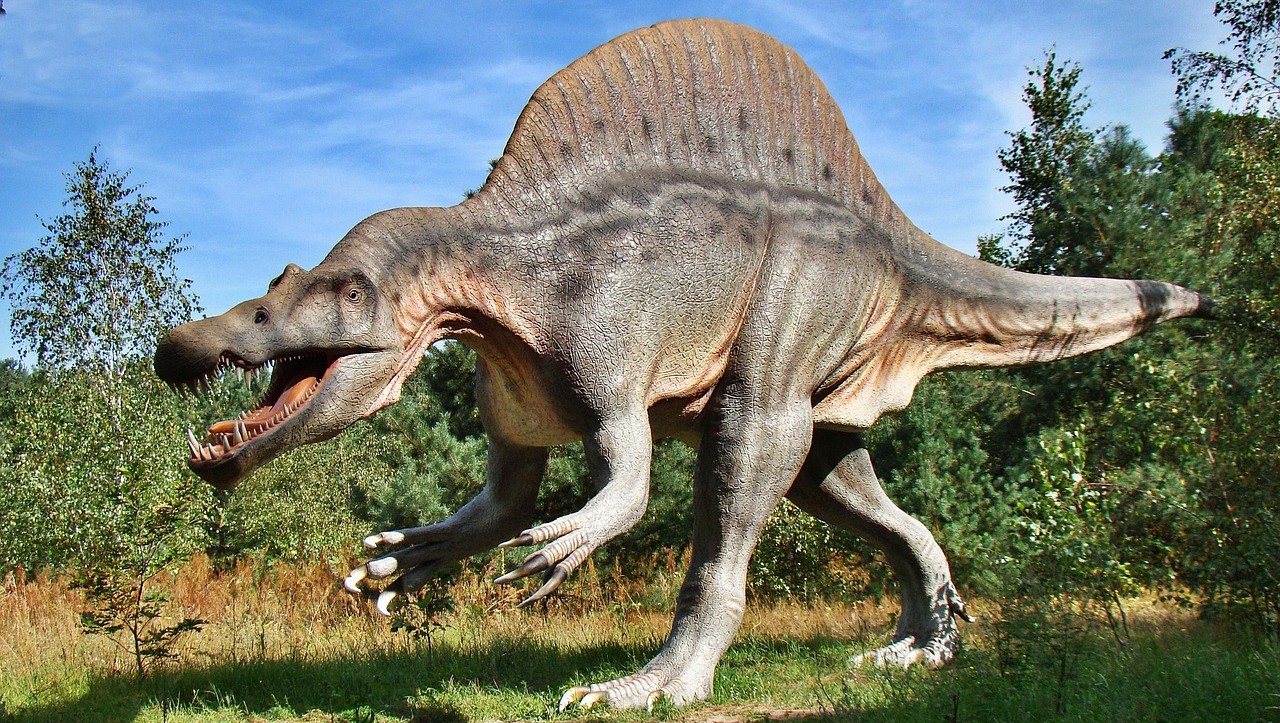
Image: Dieter Löffle

The United States of America has hundreds of years of history, and many people lived and built their lives on this land long before 1776. But 65 million years ago, the Earth was very different, and this territory was home to massive prehistoric creatures: the dinosaurs. Did you know the first partial Tyrannosaurus rex skeleton was discovered in Montana ? Fortunately, many other fossils have been found as well, allowing us to learn about these 10 incredible dinosaurs that once roamed what is now America!

1
Triceratops

Image: K. Mitch Hodge

One of the most popular dinosaurs of the Late Cretaceous was found in what is now Montana, Wyoming, Colorado, and South Dakota. We're talking about the Triceratops , known for its large bony ridge on the back of its head and its three horns . Despite being a herbivore, the Triceratops was huge, weighing between 6 and 12 tons and growing up to 30 feet in length and 10 feet in height!

2
Allosaurus

Image: The frolicsome Fairy

The Allosaurus lived approximately 150 million years ago, and its fossils were found in the areas occupied today by the states of Colorado, Wyoming, and Utah. With a size that could reach 39 feet in length and weighing about 2.5 tons, Allosaurus was a massive bipedal carnivore, which means it walked on two large, strong hind legs!

3
Ankylosaurus

Image: Blond Fox

If there was one creature that looked truly prehistoric, it was the Ankylosaurus , which lived around 66 million years ago and roamed the areas now known as Montana and Wyoming. It could grow up to 30 feet long and weigh about 8,000 pounds! It was herbivorous, but its body was like a tank, covered with thick bony plates and protective spikes.

4
Ornithomimus

Image: Tina Hartung

Now it's the turn of a very special specimen: the Ornithomimus . This peculiar dinosaur, whose fossils were found in the western United States, was light and fast. It weighed up to 300 pounds, not much compared to its colleagues. It looked more or less like an ostrich, and scientists believe it even had feathers on its forelimbs .

5
Coelophysis

Image: Kvnga

Coelophysis was another bipedal dinosaur that lived about 210 million years ago . Fossils of this species have been found in what is now New Mexico, Arizona, and other parts of the American Southwest. Unlike Allosaurus , Coelophysis was small, light, and fast, measuring between 6 and 10 feet in length and weighing roughly 60 pounds.

6
Maiasaura

Image: Yena Kwon

The incredible Maiasaura lived about 75 million years ago and was discovered in North America, specifically in Montana. It was a duck-billed herbivore, and according to research, it devoted a lot of time and dedication to the care of its eggs. In fact, its name means "Good Mother Lizard." Cute, isn't it?

7
Deinonychus

Image: Jossuha Théophile

Deinonychus is the name of this dinosaur that lived around 110 million years ago , with fossils discovered mainly in Montana, Wyoming, and Oklahoma. This carnivore is believed to have hunted in packs —a behavior that, if true, would have made it even more terrifying!

8
Stegosaurus

Image: Lucas George Wendt

We return to the "-saurus" with Stegosaurus , whose image is one of the most iconic, thanks in part to movies. Yes, it’s the big dinosaur with a long tail and bony plates running along its back . This 7-ton animal’s fossils have been found in Colorado, Utah, and Wyoming. Despite its massive size and weight, Stegosaurus had a very small brain .

9
Diplodocus

Image: Arthur Shuraev

Diplodocus was one of the largest dinosaurs ever to walk the Earth , and its footsteps left their mark in the lands of Colorado, Wyoming, Montana, and Utah. It could reach up to 100 feet in length, thanks in part to its incredibly long neck, and weighed between 15 and 30 tons. Yes, it’s the dinosaur that reminds many people of the Loch Ness Monster !

10
Tyrannosaurus Rex

Image: Tofan Teodor

We saved the best for last. The star of the dinosaurs is undoubtedly the popular Tyrannosaurus rex , or T. rex for friends. Its fossils have been discovered mainly in the western United States. This huge dinosaur lived between 70 and 66 million years ago and had an imposing body: it could reach 40 feet in length, stand 12 feet tall at the hips, and weigh an incredible 8 tons —as much as a bus!


History History 3 min read

Lawn and order

How the American lawn was born: 10 moments that shaped our frontyards

Image: Gunnar Ridderström

The American lawn didn’t sprout overnight. It grew from European ideals, industrial changes, suburban planning, and clever marketing. From elite colonial estates to postwar tract homes, each step shaped how grass became a national obsession. Here are 10 factual milestones that explain how a simple patch of green became a defining feature of U.S. domestic life.

1
European origins

Image: Martin Zenker

Lawns — and by lawns we mean closely mown grassy spaces — began appearing in 17th- and 18th-century Britain and France as signs of wealth. This was because only aristocrats or large estates could afford to keep grass short and manageable.

Before mechanized tools, scythes, shears, or grazing animals were used to maintain lawns, so turf was largely limited to those who could own the necessary manpower or animals. Early American colonists imported these aesthetics and tried to replicate them in their architecture and homes, albeit less formally.

2
Public parks set the bar

Image: Carl Newton

Early urban park designers, strongly influenced by European landscaping ideas, laid out wide expanses of turf in city parks, showing the public a "civilized" green aesthetic. That made clipped lawns part of the civic-space ideal, and not just a private luxury.

These parks helped cement the association between grass lawns, order, leisure, and modern urban life in American culture.

3
Mechanical breakthroughs

Image: Daniel Watson

In 1830, English engineer Edwin Beard Budding patented the first mechanical lawn mower, inspired by a wool-mill reel used to trim cloth.

Budding’s design used a cylinder of blades powered by a rear roller, making it easier to cut grass evenly, and largely replaced laborious scything or grazing, cutting down the cost of maintaining such status symbols in the process.

4
Et pluribus lawnus

Image: Gang Hao

Once affordable lawn mowers—including lighter push-mower variants in America—became popular, maintaining a lawn became feasible for aspiring middle-class homeowners.

This sparked a major transformation in both private and public architecture, as many well-to-do homes that before could not afford it began attempting to replicate the European lawn style in some fashion or another.

5
Suburban dreams

Image: Venrick Azcueta

For decades, lawns remained a steady feature of American architecture and green-space design; however, it wasn’t until after WWII that the true lawn boom began. Returning veterans and government-backed mortgages fueled rapidly expanding suburbs.

Developer William Jaird Levitt and his company built thousands of nearly identical homes, each with its own front and back lawn. By the 1950s and ’60s, lawns had become central to the "American Dream," symbolizing stability, middle-class respectability, and neighborhood uniformity.

6
A bit of chemical help

Image: Victor Furtuna

After the war, synthetic fertilizers (derived partly from wartime chemical technologies) became widely available to consumers, enabling lush, uniform lawns even in soil and climate conditions unsuited to grass.

This lowered the barrier to achieving a "perfect" lawn, further popularizing lawns as part of the American identity and raising the expectations of what the perfect lawn should look like.

7
Begone, pesky weeds!

Image: Dmitry Burdakov

In addition to fertilizers, in 1944, researchers discovered 2,4‑Dichlorophenoxyacetic acid (2,4-D), the first widely effective selective herbicide — killing broadleaf weeds while leaving grasses largely unharmed.

Deployed commercially soon after WWII, 2,4-D made maintaining uniform, weed-free lawns much easier and was quickly adopted in home lawn products.

8
Thou shalt keep thy lawn green

Image: Tiago Rodrigues

As suburbs proliferated, lawn maintenance became a shared social norm — homeowners' associations and neighborhood covenants often started to expect regular mowing and upkeep.

Keeping a well-groomed lawn became not just an aesthetic choice but also a mark of civic responsibility and conformity to norms.

9
Environmental worries

Image: Rémi Müller

By the mid- to late 20th century, the ecological cost of the lawn aesthetic became visible: heavy water use for irrigation, chemical runoff from fertilizers and herbicides, and reduced biodiversity as a consequence.

These drawbacks spurred both scientific and public debate about the sustainability of the traditional lawn model — especially in water-scarce regions, where it was both impractical and resource-intensive.

10
The birth of mixed lawns

Image: Ruben Sukatendel

Growing environmental awareness, droughts, and changing tastes have prompted many homeowners and municipalities to adopt drought-tolerant landscaping, native plants, or mixed-species yards instead of the traditional uniform turf.

As a result, today the "ideal lawn" is evolving as we speak: classic turfgrass still remains common, but alternative yard styles now offer more varied ecological, economic, and aesthetic options.

General General 4 min read

American hidden food treasures

10 regional American dishes you've probably never heard of

Image: Petter Boccia

America's culinary landscape stretches far beyond burgers and apple pie. Tucked away in small towns and regional pockets across the country are dishes so obscure that even Food Network hasn't discovered them yet. Let's take a delicious road trip through America's most wonderfully weird regional specialties .

1
1. Goetta (Cincinnati, Ohio)

Image: Austin Ban

Goetta is a mixture of ground meat, steel-cut oats, and spices that Cincinnati has been frying up since German immigrants brought the recipe over in the 19th century. It's pronounced "get-uh," and locals are passionate enough about it to hold an annual Goettafest.

The oats give it a texture that's simultaneously crispy and tender when pan-fried, creating something that's part sausage patty, part savory oatcake. Cincinnatians slice it thick and serve it alongside eggs, or get creative with goetta burgers and sandwiches.

2
2. Pasties (Michigan's Upper Peninsula)

Image: Annie Spratt

The Upper Peninsula of Michigan is practically its own country, and its national dish is the pasty— a handheld meat pie that Cornish miners brought to the copper mines in the 1800s . These aren't dainty; they're hefty D-shaped pockets of pastry stuffed with beef, potatoes, rutabaga, and onions that could double as hand warmers in a blizzard.

The genius of the pasty was its portability and built-in plate. Today, you'll find pasty shops scattered across the U.P., each claiming the most authentic recipe.

3
3. Frito Pie (New Mexico)

Image: Dollar Gill

This isn't plated food— it's literally served in a torn-open bag of Fritos corn chips, topped with red or green chile, cheese, and onions . You eat it with a plastic fork while standing at a high school football game or state fair.

The dish embodies New Mexico's chile-obsessed culture, where "red or green?" is practically the state motto. The Fritos get soggy in all the right ways, absorbing the spicy chile while maintaining just enough crunch to remind you they're there.

4
4. Scrapple (Mid-Atlantic, especially Pennsylvania)

Image: Theme Photos

Scrapple is what happens when Pennsylvania Dutch settlers decided that absolutely nothing from a pig should go to waste. It's a loaf made from pork scraps, cornmeal, and spices, then sliced and fried until crispy .

The texture is distinctive—crispy on the outside, soft and almost pâté-like inside. Philadelphians and Delawareans grow up eating it alongside eggs, though the rest of the country largely treats it with deep suspicion.

5
5. Burgoo (Kentucky)

Image: Artur Kornakov

Kentucky's contribution to the stew hall of fame is burgoo, a thick, slow-cooked concoction that traditionally contained whatever meat was available—sometimes mutton, sometimes squirrel. Today's versions stick to more conventional proteins like chicken, pork, and beef, mixed with every vegetable imaginable in a tomato-based broth.

Burgoo is serious social food, cooked in enormous quantities for church gatherings, Derby parties, and political rallies. The cooking process takes hours, sometimes overnight, until everything breaks down into a thick, hearty mixture that's more texture than individual ingredients.

6
6. Chicken Bog (South Carolina)

Image: Douglas Fehr

It's a one-pot dish of chicken, rice, sausage, and spices cooked together until the rice absorbs all the flavorful liquid . The "bog" refers to the thick, creamy consistency, though no actual wetlands are harmed in the making.

This dish turns up at family reunions, church suppers, and fundraisers throughout the Pee Dee region of South Carolina. It's essentially a drier, heartier cousin of chicken and rice, with smoked sausage adding a smoky punch.

7
7. Tavern Sandwich (Iowa)

Image: Jessica Tan

Iowa's tavern sandwich is what happens when a sloppy joe goes to finishing school. It's seasoned ground beef served on a bun, but unlike a sloppy joe, there's no tomato-based sauce . Just perfectly spiced, slightly steamed ground beef piled high and falling apart in the most dignified way possible.

The sandwich gained fame through the Maid-Rite restaurant chain, founded in Iowa in 1926. The meat is cooked with a secret blend of seasonings and stays loose rather than being formed into a patty.

8
8. Boiled Peanuts (The Deep South)

Image: Tom Herman

These soggy legumes are sold from roadside stands in the Carolinas, Georgia, Alabama, and beyond, often out of slow cookers perched on card tables. They're warm, salty, and utterly unlike any peanut you've eaten at a ballgame .

The texture shocks first-timers—soft and almost bean-like rather than crunchy. You pop open the shell, squeeze the peanuts into your mouth, and toss the hull. Cajun-spiced versions add heat to the mix.

9
9. Runza (Nebraska)

Image: ClickerHappy

Nebraska's state snack is the runza, a rectangular pocket of yeast dough stuffed with seasoned ground beef, cabbage, and onions . German-Russian immigrants brought this handheld meal to the Great Plains, where it became so beloved that an entire fast-food chain bears its name.

The beauty of the runza is its portability and balanced flavors. The sweet, slightly tangy cabbage cuts through the savory beef, all wrapped in soft, golden bread. Nebraskans eat them at football games, after school, and whenever they need portable comfort.

10
10. Slug Burger (Mississippi)

Image: Mike

Mississippi's slug burger has nothing to do with garden pests and everything to do with Depression-era ingenuity. When meat was expensive, cooks in Corinth stretched ground beef by mixing it with flour, potato flakes, or even cornmeal before forming patties and deep-frying them .

Today, this crispy, slightly bready burger remains a regional treasure, especially during the annual Slugburger Festival. The extenders give it a unique texture—crunchier outside, denser inside than a regular burger. It's served on white bread or a bun with mustard, pickles, and onions.

Explore more American facts

Choose your favorite category!

General
General

As American as apple pie—the very best America has to offer!

Culture
Culture

Delve into the astounding richness of American lore.

Geography
Geography

Hop in and explore vast and diverse American landscapes.

History
History

Discover the key moments that shaped the United States.