Geography Geography 3 min read

Let’s go book-gazing!

Beyond books: 11 breathtaking libraries you are going to want to visit

Image: Clay Banks

Whether you're a book lover or not, there's something magical about stepping into a beautiful library—the scent of old volumes, the quiet hum of readers, and the sheer architectural grandeur. Some libraries across the US are among the most enchanting places you can walk into. Here is a list of 11 stunning libraries worth exploring, even if you're not a bookworm!

1
Library of Congress

Image: Vincent Yuan @USA

Of course—the beating heart of American knowledge! As the largest library in the country and the world , it holds millions of books, rare manuscripts, and historical treasures.

Its grandeur isn’t just in its collection. Take the Thomas Jefferson Building: with its elaborate ceilings, marble columns, and frescoes, stepping inside feels like walking into a cathedral. Ever wanted to see an original Gutenberg Bible? This is the place.

2
New York Public Library

Image: Ran Ding

Patience and Fortitude stand guard—those are the two iconic stone lions flanking the entrance. The New York Public Library’s main branch is a true city landmark.

Step inside the Stephen A. Schwarzman Building, with its grand marble-lined halls and sweeping staircases. Don’t miss the Rose Main Reading Room —an awe-inspiring space adorned with murals, chandeliers, and rows of inviting wooden tables.

3
Boston Public Library
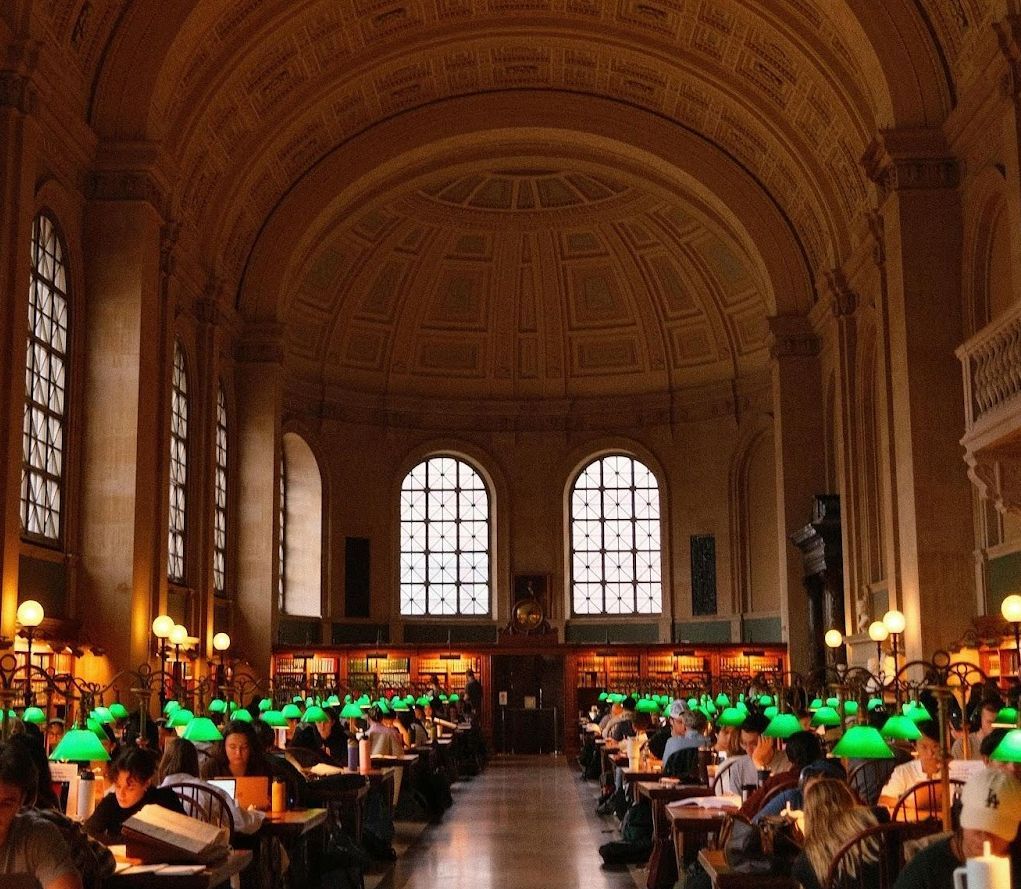
Image: Wendy Wei

A library so impressive it feels like it should charge an admission fee—but lucky for us, it doesn’t! Established in 1848, it was the first large free municipal library in the United States.

It’s home to Bates Hall, a stunning reading room with soaring barrel-vaulted ceilings and warm oak tables—a dream setting for book lovers.

4
Seattle Central Library

Image: Sylvia Yang

A sharp contrast to the historic beauties on this list, but no less worthy of inclusion. The Seattle Central Library is a futuristic masterpiece.

Designed by renowned architect Rem Koolhaas, its bold glass-and-steel exterior is impossible to miss. Inside, multi-level platforms create a space that feels more like a sci-fi movie set than a traditional library.

5
Geisel Library at the University of California, San Diego
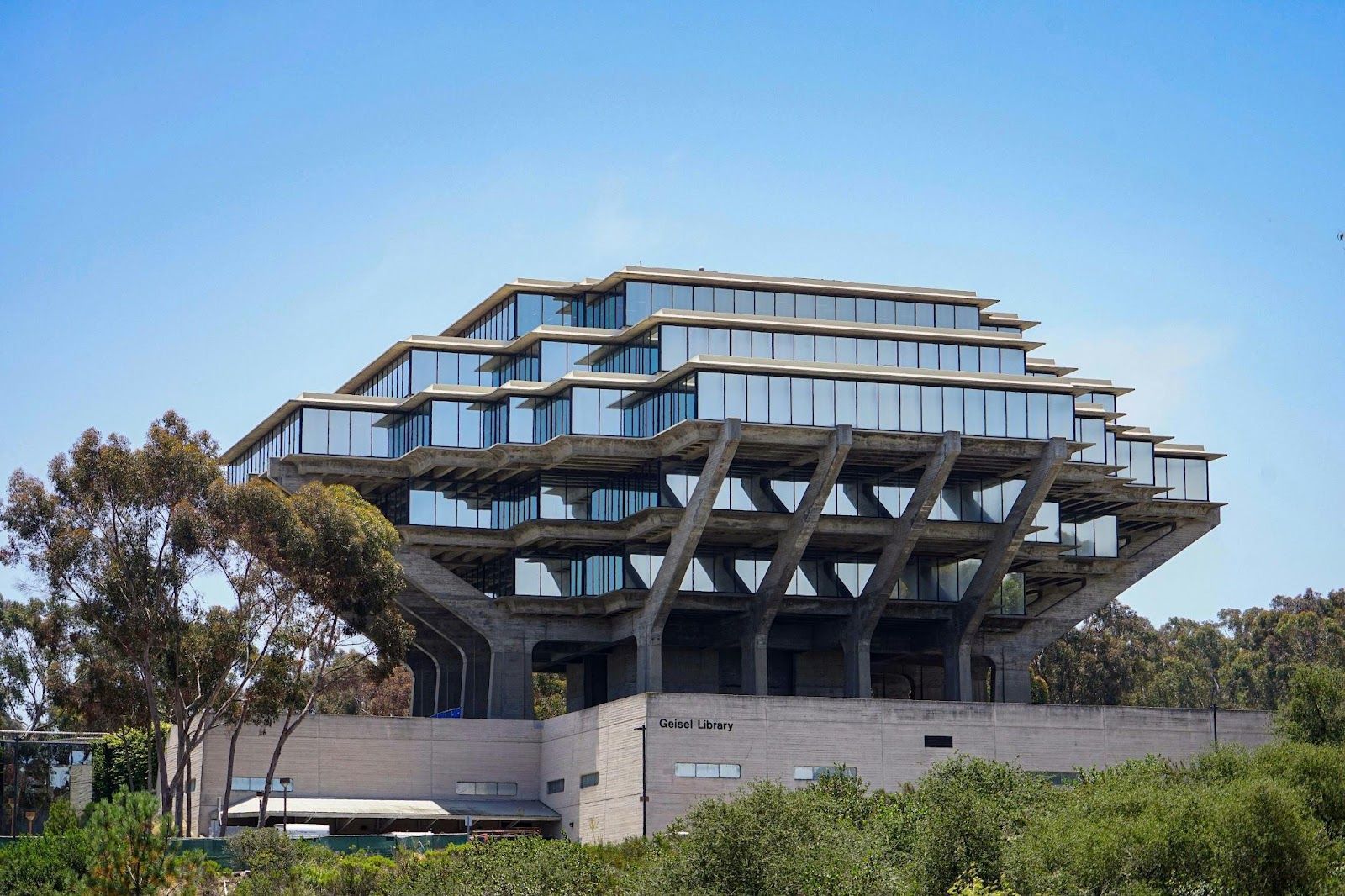
Image: Jeremy Huang

Named after none other than Dr. Seuss himself (real name: Theodor Geisel) and his wife, Audrey, this library looks like something straight out of a sci-fi novel.

Its unique Brutalist-meets-futuristic design makes it one of UCSD’s most recognizable landmarks. It houses an extensive collection—but let’s be honest, the main draw is the building itself. It’s an architectural oddity that feels both retro and futuristic at the same time.

6
George Peabody Library

Image: Elijah Hail

Some libraries feel grand, but this one feels magical . Tucked away in Baltimore, the George Peabody Library is known for its soaring atrium, lined with six stories of cast-iron balconies adorned with gilded accents.

The library’s collection specializes in 19th-century literature—but honestly, most visitors come just to soak in its beauty. It’s a book lover’s dream come to life.

7
Iowa State Law Library

Image: Muhammed A. Mustapha

Hidden inside the Iowa State Capitol in Des Moines, this library is a Victorian-era gem —think spiral staircases, intricate ironwork, and rows of leather-bound books stretching to the ceiling.

It may be lesser-known than others on this list, but it perfectly illustrates how libraries can be both functional and visually captivating. This setting alone makes you not mind so much having to do legal research.

8
Beinecke Rare Book & Manuscript Library

Image: Tim Bish

This is no ordinary library—as you can plainly see. It’s an architectural marvel . Located at Yale University, the Beinecke Library is famous for its translucent marble panels, which bathe the interior in a soft, golden glow.

9
Morgan Library & Museum

Image: mana5280

Walking into the Morgan Library feels like stepping into a European palace—pure Gilded Age opulence with ceiling frescoes, carved wood, and velvet drapes.

Originally J.P. Morgan’s personal book collection , it is now a New York City landmark and museum showcasing rare manuscripts, original works by Dickens and Austen, and even handwritten music by Mozart!

10
William W. Cook Legal Library

Image: Mathew Schwartz

Some law libraries are dull and purely functional. This is not one of them. Located at the University of Michigan, the Cook Legal Library is a Gothic gem with towering stained-glass windows, massive oak tables, and cathedral-like reading halls.

The architecture alone makes studying law feel a bit more poetic, but it’s also one of the finest academic law libraries in the country.

11
Suzzallo and Allen Libraries

Image: Cameron Stewart

This one looks like a place to learn witchcraft and sorcery, doesn’t it? Part of the University of Washington in Seattle, the Suzzallo and Allen Libraries feature a Reading Room that is a Gothic architectural masterpiece, with soaring ceilings and stained-glass windows .

Culture Culture 6 min read

Geniuses at work

We're here today because of them! Meet 10 Americans who changed history

Image: Quino Al

The United States is a land of progress and innovation, so it makes sense that many of the world's most important inventors and scientists are Americans. From breakthroughs like the lightning rod and the light bulb to advancements in the world of medicine, biology, and astronomy, there have been many men and women who, from different fields of study, have contributed to the scientific progress of our country and the entire world. Join us as we review these 10 American inventors and scientists who changed history!

1
Thomas Edison

Image: Call Me Fred

When it comes to inventors, we can't fail to mention the incredible Thomas Alva Edison.

Edison was born on February 11, 1847, in Milan, Ohio, and since he was a child, he showed his interest and talent in mechanics and electricity. At the age of 11, he set up his first laboratory in his parents' home, and by the age of 12, he ran his own business: a newspaper he designed, printed, and sold himself.

Creator of the phonograph (the first device capable of recording and reproducing sounds) and a fundamental part in the development and popularization of inventions such as the electric light bulb and the motion picture camera, Edison patented more than 1000 creations during his lifetime. Impressive!

2
Benjamin Franklin

Image: Dan Mall

Born in Boston, Benjamin Franklin was one of our Founding Fathers, the men whose principles, values, and ideas shaped America. But as if that weren't enough, Franklin was also a renowned scientist, inventor, and polymath.

A pioneer in the field of electricity, he's remembered for his famous kite experiment, which demonstrated the electrical nature of lightning and led to the invention of nothing less than the lightning rod. In addition, he's also credited with iconic inventions such as the first efficient wood-burning stove (later known as "the Franklin Stove"), the bifocal glasses, and the glass armonica.

3
Samuel Morse

Image: The New York Public Library

Unlike other scientists and inventors on this list, Samuel Morse began his journey in a completely different field: art.

Morse studied at Yale, where he completed his studies in 1810. He then embarked on a trip to Europe to continue his artistic education, but this trip awakened another peculiar interest in him. Frustrated by the communication methods of his time, Morse focused his creativity on finding ways to transmit information over long distances using electrical signals. Thus, the revolutionary telegraph was born, along with its way of communication, the Morse code.

4
The Wright Brothers

Image: Simon Fitall

The Wright Brothers were the famous siblings who, in the 20th century, achieved a goal long sought by humanity: flight.

Wilbur and Orville Wright are credited with inventing, building, and flying the world's first successful airplane. As you probably know, on December 17, 1903, they made the first sustained flight in history using the Wright Flyer, their iconic invention.

On that December morning, the brothers flipped a coin, letting fate decide who would be the first to test the aircraft. Although Wilbur won, that first attempt failed. So it was Orville who flew for 12 seconds, traveling 120 feet over Kitty Hawk, North Carolina.

5
George Washington Carver

Image: Tom Hermans

George Washington Carver was born in the 1860s in Diamond, Missouri. In the 1890s, his intelligence and hard work enabled him to enter Iowa State College (now Iowa State University), where he earned a master's degree in agricultural sciences. In 1896, he became the head of the agriculture department at Tuskegee Institute in Alabama, where his career as a professor and a researcher took off.

Thanks to his investigations and tests, George Washington Carver made major contributions to agriculture, including his innovative techniques for crop rotation . In addition, he developed many and varied peanut products, such as oil, flour, soap, and ink, helping to make this crop one of the key products of the country's economy.

6
Carl Sagan

Image: Vaibhaw Kumar

The stars and the mysteries of the universe captivated the famous Carl Sagan from an early age. Born in Brooklyn, New York, in 1934, Sagan studied at the University of Chicago, where he earned degrees in physics, astronomy, and astrophysics, eventually working and collaborating with NASA.

His contributions to the field of astronomy earned him a position in projects such as the Mariner, Viking, Voyager, and Galileo missions, thanks to which we have learned a lot about Venus, Mars, and Jupiter. The famous high temperatures of Venus, for example, were confirmed thanks to his work.

Additionally, his book and series Cosmos attracted the public's interest in astronomy, inspiring many others to follow in his footsteps.

7
Grace Hopper

Image: Museums Victoria

While computer programming may seem like a modern issue, the pioneers of this field were already working as early as the 1940s.

Grace Hopper graduated in mathematics and physics in 1928 and obtained a master's degree and a Ph.D in mathematics from Yale University in 1934. Famous as a pioneer in the world of programming, Hopper's work began during World War II when she joined the US Naval Reserve. There, she worked on the earliest electromechanical computers and developed extensive and complex manuals to operate them.

Her greatest contribution came from her work with mathematical codes, which she translated and adapted into innovative machine-readable language. That innovation led to the creation of the first high-level programming languages.

8
Jonas Salk

Image: Олег Мороз

Jonas Salk is none other than the mind behind a medical milestone: the polio vaccine.

In the 1940s, Salk was beginning his career in medical research. While working at the University of Michigan, his work was crucial in developing the first successful influenza vaccine for the military during WWII. This event marked his later study of the poliovirus.

Polio was devastating during the first decades of the 20th century, but that changed dramatically thanks to Salk's work. The scientist led a team that succeeded in developing the first safe and effective injectable inactivated poliovirus vaccine (IPV) in 1955, and the rest is history.

9
Barbara McClintock

Image: digitale.de

Although her name may not be as instantly recognizable as some others on this list, her work definitely is. Barbara McClintock has undoubtedly made one of the most significant contributions to medicine and genetics.

In the 1940s and 1950s, she worked with chromosomes, investigating their role in inheritance, which led to discoveries that forever changed our understanding of genes.

Before her, genes were believed to be fixed and immutable. But McClintock came to change that idea with her most famous contribution: the discovery of transposable elements, aka "jumping genes." She demonstrated that jumping genes are present in multiple organisms, including humans, and play an essential role in genetic evolution.

10
Alexander Graham Bell

Image: Misho Tektumanidze

Alexander Graham Bell became interested in sound and communication at a young age, something that led to his greatest and most remembered contribution: the telephone.

Although born in 1847 in Edinburgh, Scotland, Alexander Graham Bell settled in the United States in 1871 and became an American citizen years later. It was here that he developed most of his experiments and research.

After years of experimenting with methods to transmit sound through electrical currents, Bell finally spoke into his invention on March 10, 1876, saying to his assistant, "Mr. Watson, come here. I want to see you." That was the first successful telephone call in history.

Culture Culture 2 min read

Hollywood’s top payouts

Million-dollar roles! These 10 performers got paid big time!

Image: DS Stories / PublicDomainPNG

Hollywood might seem like a land of glitz and glam, but behind the scenes, it's also home to some jaw-dropping paychecks. Some stars didn’t just act, they cashed in big. From old-school legends to today’s A-listers, these actors and actresses made movie history and a mountain of money. Let’s take a look at ten of the highest single-movie payouts.

1
Bruce Willis

Image: Stefano Pollio

When The Sixth Sense hit theaters in 1999, it spooked audiences—and simultaneously lined Bruce Willis’s pockets. He took home $14 million upfront, but thanks to a clever back-end deal, his total haul soared to a staggering $100 million. In this one, he saw green people!

2
Tom Cruise

Image: Ryuno

For Mission: Impossible 2 , Tom Cruise saved the world—and walked away with $100 million. Thanks to his producer credit and box office cut, this 2000 sequel became one of the most lucrative gigs in Hollywood history. Cruise really ran away with it.

3
Robert Downey Jr.

Image: Jason Leung

In 2018, Avengers : Infinity War pulled in billions, and so did Robert Downey Jr. Well, almost. With bonuses and back-end deals, his total payday for playing Tony Stark topped $75 million. That’s a superhero salary fit for a billionaire genius playboy, don’t you think?

4
Sandra Bullock

Image: NASA

Sandra Bullock scored big with Gravity in 2013. She earned $20 million upfront, but back-end profits pushed her total haul to over $70 million. Not bad for floating around in space—with a healthy dose of acting brilliance, of course.

5
Tom Hanks

Image: Yosuke Ota

Tom Hanks brought everyone to tears in Forrest Gump , and his deal gave him a slice of the movie’s massive success. Thanks to profit sharing, he earned around $70 million for his iconic role. Life is indeed like a box of chocolates—sometimes there’s a gold bar inside.

6
Harrison Ford

Image: Intricate Explorer

Speaking of gold, in 2008, Harrison Ford returned as Indiana Jones and struck box-office gold. Thanks to a cut of the profits, he took home $65 million for Indiana Jones and the Kingdom of the Crystal Skull . Not bad for dusting off the old fedora, right?

7
Jack Nicholson

Image: Ryunosuke Kikuno

Jack Nicholson pulled more than one trick in Batman (1989). To play the Joker, he accepted a lower salary of $6 million in exchange for a percentage of merchandise and box office profits. Guess how that ended? A massive $60 million payday. The joke was on everyone else!

8
Leonardo DiCaprio

Image: Christophe Hautier

You may think we’re talking about Titanic , but Leo’s layered performance in Inception was the one that earned him a fat check. He skipped a massive upfront fee and gambled on box office bonuses, ultimately walking away with $59 million. Looks like the dream really did pay off.

9
Johnny Depp

Image: Christopher Zenzel

In Pirates of the Caribbean: On Stranger Tides (2011), Johnny Depp took home $35 million just to show up. With bonuses, his total payout reached approximately $55 million. Captain Jack Sparrow really did find his fortune.

10
Margot Robbie

Image: Elena Mishlanova

Margot Robbie played Barbie, and for that, she banked like a superstar. Her starring and producing role in Barbie (2023) earned her $12.5 million upfront, but back-end profits boosted her total haul to $50 million. Never underestimate the power of pink strength!

Explore more American facts

Choose your favorite category!

General
General

As American as apple pie—the very best America has to offer!

Culture
Culture

Delve into the astounding richness of American lore.

Geography
Geography

Hop in and explore vast and diverse American landscapes.

History
History

Discover the key moments that shaped the United States.